AI Audio Adventures (Or How I Asked Holly+ To Eat My Song)

Music by DALL·E

In my inquiry around AI and Audio, I stumbled upon this interesting platform by musician/performer/experimental artist Holly Herndon. Her application — called Holly+ — takes an uploaded audio song and transforms it through AI and Voice into her unique musical style. I had to try it out (of course) and the results are strange but interesting.

I used a demo from a song of mine — with some lyrics from my drummer friend, Bob — called Faucet Drop (Quarantine Together).

The Holly+ tool digested the audio file and turned out a very different remixed version, for sure, but with the underlying DNA of the original demo still intact. There are no recognizable “words” in her vocal AI-infused audio, but that’s fine, as it becomes a different kind of art and collaboration.


But I also wanted to take it another step forward, by bringing me back into the mix (so to speak), so I sampled the first section of the Holly+ remix of my song, and began to make another short sample remix, adding some other elements on top, giving it a little more disorientation. In this one, it was all sampling — sections and loops, gathered together and the feel is very different.

So this moved from me to her to us.

Peace (Singing It),
Kevin

PS– Here is Herndon giving a TED Talk about AI, voice and more. (By the way, she is part of a technical team working on ways to protect artists’ intellectual property in the Age of AI through the work of Spawning, and its website: Have I Been Trained? where you can search for art that has been scraped into AI databases.

ETMOOC: The Emergence Of Deep Fake Music

AI Music by StableDiffusion

I’ve been paying attention to the ruckus over the deep fake music that has showing up on social media in the last few weeks, where an AI-influenced song – Heart On My Sleeve — using the voices of Drake and The Weeknd has shaken the music industry. The song in question was different from some of the earlier memes and remixes that were taking root in social media. In this case, it was an entirely new song by AI with the voices of the two pop stars singing new words generated by AI. And it was pretty authentic sounding, too, in terms of song theme and vocal intonations and phrasings of the two artists.

This podcast episode — The Daily from New York Times — is a good listen for an overview of the situation.

As a musician and songwriter, I find myself conflicted on the emergence of AI in the field of making music. On one hand, it opens up some interesting doors for creative composition, using sounds and voices and techniques that might not otherwise be easily available to musicians. I’ve done some explorations of AI music sites but haven’t yet been all that impressed by what I’ve found. Clearly, though, there’s more out there that I haven’t yet discovered and played around with.

On the other hand, the legal and ethical issues of copyright and intellectual property use and infringement are huge, as it has been for the AI art generation field (lawsuits are already underway over the scraping of online content to feed the AI databases) and it feels like another reminder that the AI companies will need to find mechanisms (or be forced to, via lawsuits) for recognizing the contributions of musicians to any field of AI Music. I don’t know how that will be done, but it seems important for the tech folks to figure it out.

This all reminds me a bit of an earlier post I wrote a few months back about using loop tracks to construct songs — which is something I do along with traditional guitar-in-hand songwriting– and whether that is “songwriting” or not, since I had not created the original files. The AI revolution takes that idea and pushes it about 100 notches further, in my opinion.

I’ll keep an eye on this field of AI Music, as songwriter, musician, fan.

Peace (and Sound),
Kevin

PS — Update — I wanted to try out making a song via AI, so I used UberDuck’s tool to create this rap: https://app.uberduck.ai/rap/song/6908cc42-58d3-4f3f-8411-5f3faf844270 

I can’t say I am all that impressed but it was interesting. I also used the free account, which is clearly limited in many ways.

Musical Composition: Listening To Landscapes

My National Writing Project friends down in Southern Connecticut are hosting an event this month at the Weir Farm National Historic Site, inviting their educators to a theme of “Reading Landscapes & Writing Nature” for the 2022 Write Out Project. Bryan C shared out a StoryMap he has been building, and shared it out, and I followed his map and story, but I kept coming back to the phrase: Reading Landscapes.

I had this inspiration to make a piece of instrumental music, using that theme of “Reading Landscapes” that eventually morphed into “Listening To Landscapes” as my guiding muse. So I pulled out my keyboard, opened up some music software, and began to compose.

All through the making of the music, I had certain memories in my mind — of wandering through a forest on a path, of pausing on a rocky overlook on a mountain top, of floating on a river on kayak, of sensing peace in a dark wooded area, of returning to the path.

My piece — A Quiet Walk In Four Parts (Listening To Landscapes) — captured what I was remembering, and imagining, and “reading” the landscape from previous outdoor adventures, and each “path” wanders musically into the next.

Thank you, Bryan, for setting song in motion.

Peace (play it),
Kevin

On Songwriting Part 7: Getting Back To Bare Bones

(This is the seventh of a series of posts about writing songs. Read the first post, second post,  third post, fourth post, fifth post, and sixth post, if interested)

In my previous post in this series designed to reflect and pull back the curtain on my process of writing and recording of a brand new song — Million Miles Away (From Finding Me) — I shared a somewhat slick, produced final track that featured a wide range of instruments and loop, layers upon layers.

But I could not escape the sense, as I listened, that the song in that particular version had come to seem a bit cold and over-produced to my ears, even though I had a lot of fun with the creative energy and the hours that went into making the song sound like that. Mixing and making loops, and recording real instruments to add on top, and playing with sounds — I love all that stuff and get lost in it.

When I finished the production and shared that version of the song out, though, I wondered aloud if I needed to get back to just guitar and voice.

I did. So I did.

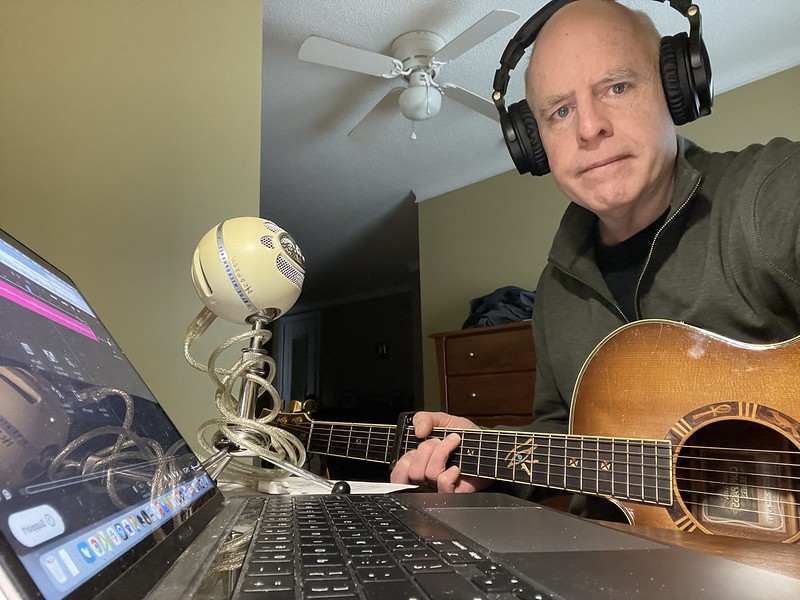
Million Miles studio pic

And I know I can hear the difference with this stripped down version — it’s the version I hear in my head when I was writing the song. (Which makes me think to that old VH1 Unplugged series in which famous musicians showed up with only acoustic instruments to play their most popular tracks and how some of those performances were magical because they exposed nuances in songs that weren’t always evident in the electric versions — see Nirvana, as example).

Take a listen to my acoustic version of Million Miles Away:

I do think that all the work I did in polishing up the song in the production version in my, ahen, “studio” (ie, corner of my room) was worth it — it forced me to listen to the song closely, day after day, and to tweak the lyrics and timing of the voice, and all that planning and thinking and tinkering informed even this acoustic version, even though it very basic in nature.

What is most different here, though, is that the lyrics surface, allowing the song to take a breath in the space between the guitar and the voice. In the earlier version, every gap felt crammed with sound. The song got crowded. The words suffocated beneath the tracks of instruments and the steady drum track that allows no detour. Here, with this recording with no metronome and only one guitar as I sing, I think, the song and lyrics have found some freedom to linger in the air a bit longer.

Thanks for reading and listening along with me. It’s been fun. Now, it’s on to other songs and poems …

Peace (singing it),
Kevin

PS — if you want to see a video of me recording the acoustic version I have shared here in this post, this link will give you a look at me, my guitar and my basic set-up.

On Songwriting Part 6: A Voice In The Mix

(This is the sixth of a series of posts about writing songs. Read the first post, second post,  third post, fourth post, and fifth post, if interested)

I’ve been tracking the writing and recording of a new song — Million Miles Away (From Finding Me) — as a way to reflect on my songwriting process. I’m not sure if too many other people are interested but if you are here: welcome.

In the week or so since my last post, I’ve been tinkering with layers on the music of the song, trying to wrestle it into some form of existence that I find satisfying. I’ve added instruments and taken them away. I’ve walked away from it more times than most just not all that satisfied, feeling (as I mentioned last post), that the production I have done is too contained, too restrained, as the foundation of drums and piano and bass were built mostly upon modified loops. That said, the layering of vocal “ahhs” at the opening and in the chorus sections, the distorted guitar on top of the bridge, and the simple percussive bell keyboard melody after the last verse all help offset the “in a box” feel, I hope.

Then there is my vocal track. I kept trying to find time in the house when no one was around, as I am pretty self-conscious about singing new songs, and I know my voice has many limitations (along with some interesting qualities, if I get it right, which is not all that often). Last night, I realized: no one else is in the house, and I rushed to get my microphone, headphones, computer and lyric sheets all set up, and then spent time recording the vocals (disrupted at times by the dog, barking at her tennis ball).

It came out OK, I guess, but I still feel like this produced version of the song is not the version I have in my head — it doesn’t have the intangible thing that led me write it in the first place and stay with it so long —  and interestingly, every time I practice the song on acoustic guitar, I think: THIS is the version of the song that seems most true to what I was writing.

So, with all that said, here is what I am calling the Production Version of Million Miles Away, with many layers of instruments. I like it OK. I don’t love it but I appreciate it for what it is: an final step in an experiment of bringing a song from start to finish in the open. At one point, I tried to add some higher backing vocals to some lines in the song that could use more texture, but that failed miserably and I lost patience so I abandoned that idea. I have some visions of recruiting a real singer to sing it, but that may be at some point down the road, when I am ready to let the song go.

My next, and maybe last step, interestingly enough, is going to be to do an acoustic version of the song — low production value — focused on guitar and voice, as I see if I can capture the heart of the song in the way I hear it in my head. That’s for another day.

Peace (produced in loops),
Kevin

On Songwriting Part 5: Building The Tracks From The Ground Up

(This is the fifth of a series of posts about writing songs. Read the first post, second post,  third post, and fourth post, if interested)

Note: After spending quite a bit of time working to produce tracks of music for this ons song that I am writing and reflecting on out in the open, I sort of still like the rawness of the early versions where it is just guitar and rough voice. I may yet abandon what emerged and described here in this post, but not yet. I’m going to continue my song quest forward.

In my earlier posts, I shared how I took an idea built of a chord pattern and opening line of a song, worked through drafts of lyrics, developed a verse and chorus, and began to construct a new song out here, in the open, as part of a creative reflective practice. (See the links above if you want to read and listen to what I had been up to from the start)

With the lyrics mostly together, and solidified, with only a line or two still being tweaked now and then as I practice the song — Million Miles Away (From Finding Me —  I decided to try my hand at building and producing an instrumental backing music with technology. Initially, as almost always, I was on my acoustic guitar, with the chords and words and paper. In turning to Garageband, and Soundtrap, as digital music stations, I was hoping to turn the song at a slight angle, with layers of sound.

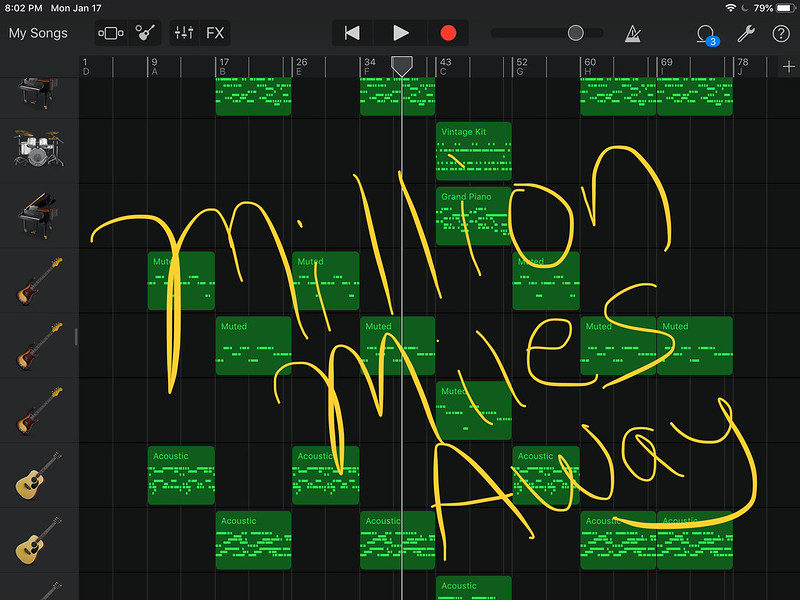
I began in Garageband, on the app on my iPad, and started with drum loops, and then added piano, and then bass and so on. I added, and removed, other instruments that either didn’t work for my ears, or became too cluttered for the sound of the song that I could hear in my head. Still, I kept some guitar, percussion (in two sections) and organ in there.
Million Miles Cover

Even this screenshot shows how many layers are in there, and the tracks are divided up by song sections — the verse, the chorus and the bridge. Here’s a little snippet from the center of the song, so you can get a listen to how the layers are working together at this point. If you have been following this series, you may hear how different the feel is with this, as opposed to my earlier demos. It’s both intentional, and not, if that makes sense, as the automated loops began to shape the song anew in my ears, through my own choices of instruments (the piano gives an entirely new texture) and patterns.

Using and remixing loops in an app like Garageband is fun, and it’s relatively easy, but it also risks generating a fairly sterile sound, as everything is locked in perfect place with the unforgiving metronome, and this is what continues to nag at me here, even as I think about how to wrangle some imperfections in there. To humanize the looped sound. It is this notion of loop track perfection that had me writing the first thought that began this blog post (above) — a reason that I still might ultimately scrap this whole song construction I am outlining here and begin from scratch all over again on guitar.

But not yet. So …

I moved that mixdown of tracks out of Garageband and into Soundtrap, another music recording platform which has some nice options for live recording, and then layered in my own acoustic guitar, giving it more of the original feel of the song, which the piano tracks, while nice, didn’t capture in my ears. The live guitar, while intentionally not very prominent in the mix, gives the song a little extra of something. I play off the beat at times, filling in the robotic metronomic forward motion of what I built in Garageband.

Take a listen to this snippet.

I’ve since added some vocal backgrounds (ahhs) and a section of power chords for electric guitar for the bridge section but I don’t have that ready yet to share.

My next step will be to record some lead vocals, which I will do as another track in Soundtrap. I may add some more live keyboards (myself, playing, as opposed to loops) at the end, to give the second half of the song more texture. In regards to vocals, I aim to do my best, but in my mind, I keep wondering: Who else could I ask to sing this? Or help me sing this? A backing track might make all the difference in the world.

Peace (continuing on),
Kevin

On Songwriting Part 4: Getting It Down As Demo

(This is the fourth of a series of posts about writing songs. Read the first post, second post and third post, if interested)

I’m always anxious about my singing voice, which is one reason why I always am ready to call anything I record a “demo” and cover myself from criticism (that I can’t sing as well as I should be able to, given how many years I’ve been at this).

So, in that vein, I’m going to be sharing a demo recording of the song that I have been writing, and writing about, in the open. The song is titled Million Miles Away (From Finding Me).

A demo recording is valuable for me as a songwriter because it sets into “tape” (or app) how I am hearing a song still in development. You’d think if you were writing a song, you would remember how it goes when you took a break and came back to the song.

If only.

I can’t say it happens often, particularly if a song is worth keeping and the melody line is running in my head, but there have certainly been more times than I like when I have returned to a lyric sheet and picked up my guitar, and forgotten a little melody line that is the heart of a lyric or a line or the song. If I have not have the foresight to record even a rough version of the song, I have to walk away in frustration. Sometimes, the lost piece will return the next time I try the song.

A demo recording at least preserves some version of the song as it is being written, and almost always, my demos are only guitar and voice, recorded these days on the Voice Memo app on my phone, and then moved over to my computer. In the early days, it might have been a cassette player or four-track machine.

For this new song that I have been writing about recently, this audio demo followed yet more minor revisions to the lyrics (something I wrote about in Posts 2 and 3) as I fine-tune words and phrases a bit. For demos, I just hit “record” and start playing, and as long as I don’t completely flub it up, it’s a keeper.

Listen to the first part of the demo of Million Miles Away (From Finding Me).

The next step for me now is to determine if the song is worth a more focused recording session on my computer, in which I would record the guitar separate from the vocals, and maybe have a drum track, and other instrumentations on it. I’m leaning towards that for this one, if only to complete this reflective writing adventure.

And I still like the song enough to keep pushing forward.

Peace (singing it),
Kevin

On Songwriting Part 3: Annotating Lyrics

(This is the third in a series of posts about writing a song. Read the first post and the second post, if interested)

For years now, I have valued many annotation adventures, either on my own or with friends. With tools like Hypothesis, NowComment, Vialogues and more, it’s never been easier to engage in a text, whether your own or someone else’s. Adding layers of questions, comments or just reflective observations over text and images and other media makes the act of reading more engaging and more interesting, I think.

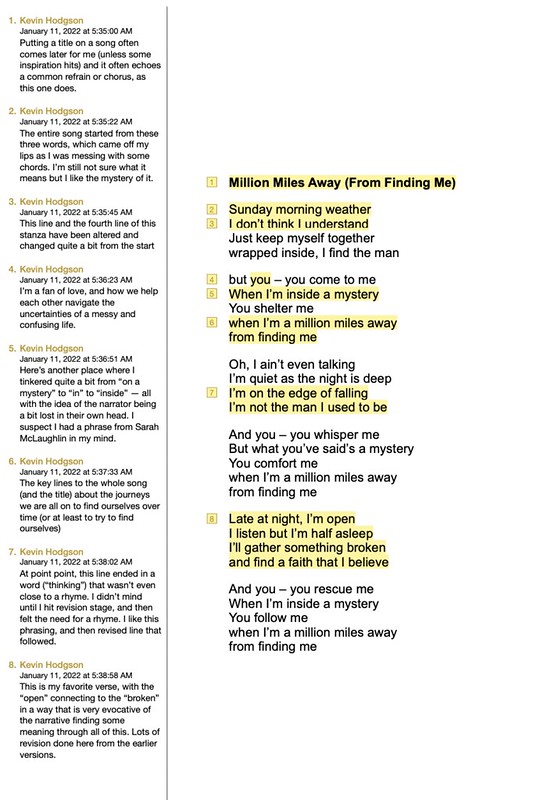
Here, in this third post about songwriting, I wanted to annotate my own lyrics, for a song I have been writing and blogging about in this series entitled A Million Miles Away (From Finding Me). The lyric sheet is still somewhat under construction — in that, I may still tinker with the phrasings — but for the most part, this is where I am at with the writing of the words of the song and its story of a narrator grappling with some confusion about life.

The annotations – which I did in a text editor — allow me to speak from the margins about intentions, and techniques, and struggles, too, with finding the best way forward with a new song.

Annotated Song Lyrics

I invite you to annotate, too, if you want.  I have created a published Google Doc, which I then popped into Hypothesis.

Peace (singing it),
Kevin

On Songwriting Part 2: What A Mess I’ve Made

(This is the second in a series of posts about writing a song. Read the first.)

I’ve tried often to fix my handwriting but it’s too far gone at this point to do much about it. My decade as a newspaper journalist — scribbling notes as I interviewed people — ruined my handwriting, which was never great to begin with. Often, I apologize to my students for notes I put on their papers, and interpret what I wrote.

I mention this conundrum with handwritten text because when I am writing a song at my little corner in the house, with my guitar in my hands and a notebook and pencil nearby, I am often scribbling frantically to catch any words or phrases or lines that might be useful, and worth remembering. If I don’t write it down, I am apt to forget it, and often, the first way a phrase has tumbled out of my mouth is the most interesting.

For the most part, I can sort of read what I have written. But not always, and I’ve been frustrated at times when I come back to a lyric sheet in my notebook and can’t make heads or tails of some words or a line. I try to remember before taking a break or quitting for the day to read, and at least try to fix, anything that looks like it might be beyond recognition the next time I read it.

What I find interesting, though, is how the notebook pages are a map of what has happened with a song, as I move parts or change words or scratch out entire sections as the meaning of a song emerges or changes or shifts. I’ll draw arrows, and circle words, and indicate rhythmic emphasis on the start of a sung line.

From the outside, it’s a mess. For me, it’s the thing, the process where everything is made visible to me as a songwriter.

Here, for example, is the paper with my notes for the song that I am currently writing — the song that started me on the creation of this series of posts — which now has a working title of Million Miles Away (From Finding Me). This lyric sheet has more doodles and scratches than most, for I was having lots of problems with some of the ways the lines were ending, and I was working and reworking, and trying to track my ideas as the story of the narrator began to emerge.

Song Lyric Sheet

The following collage shows three versions of the same sheet of paper (wouldn’t it have been cool if I had had the foresight to set up a stop-motion capture of this paper from blank to finished?) where the opening verses and chorus came rather quickly, and then the revision process began with my chicken-scratch of the latest version (see above).

Song Lyric Collage

One I reach a point where I have most of the words and lines in place, I move over to the computer and type up a version to print out, and I put the notebook aside and work with that typed piece of paper. This allows my mind to not worry too much about navigating all the arrows and circles and pencil marks. Once again, I am trying to balance word flow and song rhythm, while staying true to the story of the song (in this case, a narrator grappling with self-doubt and an internal and nocturnal journey to think deep about where life is headed … you know, light stuff.)

Song Lyric sheet typed

Peace (always in revision),
Kevin