Blogging4Life: Why I Started Blogging

This is one of a series of posts answering some questions about a life of blogging that started (I believe) via Tom Woodward, (maybe via this blogger) but that I first saw via Alan L, Sarah H and Martin W through a renewed push to return back to blogging spaces and away from corporate social media platforms. I am breaking down the series of questions into different blog posts.

Q: Why did you start blogging in the first place?

Way back when, at the end of my first year of teaching (summer 2003), in my Summer Leadership Institute with the Western Massachusetts Writing Project, we piloted what we were told was “blogging” for the National Writing Project. (This was just after presidential Howard Dean used a blog to raise donations). I don’t remember the platform anymore and it is long since gone. Oh wait. Manila. That was it. Anyway, we used it to share stories, professional thinking about teaching, for comments and more. Even though we were in the same location, we immediately could see the potential for feedback and sharing and publishing. I sure did, and I even got NWP folks to give me a Manila blog space for my students.

I tried to use the Manila space for different activities over the next year or two. It never quite caught on. The concept was too new, I think, and the administrative elements of Manila were clunky and sometimes unstable. But then, a few summers later, at a technology retreat for NWP out in Chico, California, called Tech Matters, some new teaching friends I met there encouraged me to start my own blog after showing me their new blogs (this teacher-as-blogger was now starting to be a thing).

But I wondered: What would I say? What did I have to say?

I decided to dip my toes in, and created the Kevin’s Meandering Mind name and concept to keep many doors open to wherever my curiosity took me — teaching, music, writing, poetry, comics, video production, photographs, family. While my posts are indeed all over the conceptual map, I know I found my writing voice in those regular posts (during one stretch of time, I was posting twice a day — which is insane. I apologize to anyone who had me in their RSS reader.) Here is my first post, ever. Notice the technology references, including Writerly before Google snatched it up and made it Google Docs.

Back to the question at hand, as to why I started blogging, I think it was to have a place to write, pure and simple. Or maybe a place to compose is the better way to put it.

(see my post from 2009 about Why I Blog)

Peace (wherever your letters land),
Kevin

Write Out/Write Across America: Poems Of Place

We Write By Night

Last night, I helped co-facilitate an online writing marathon session through the National Writing Project’s Write Across America project, and in connection with the coming Write Out project. Our focus was on the Connecticut River Valley of Western Massachusetts, and poetry (although participants could write what they wanted). My facilitators were Harriet K. (a colleague with the Western Massachusetts Writing Project) and Ranger Wes (of the Springfield Armory National Historic Site).

We used this StoryMap that I developed over the summer, with pins and points of poets in our part of Massachusetts. (The map was a hit! Phew.)

Two of the poems I wrote last night were connected to a pin for the Poet’s Seat Tower, a brick tower where poets used to walk to, to write in peace and solitude.

The first poem, above, used the metaphor of the bricks of the tower. The second poem, below, was inspired by a link to an Herbarium space, and its digital collections (which are amazing) and the space for glass slides of the anatomy of trees.

Wood Anatomy

Peace (from every place),
Kevin

A Land Has A Story

Land Abstract

I was perusing through a Story Map of prompts from the Iowa Writing Project (for the National Writing Project’s Write Across America — my writing project is host for October!) and came across the concept of Land Abstracts, the recorded deed of owners of a piece of land, passed down from generation to generation as a legal document. My morning poem stemmed from that concept.

The narrative arc
of the story
of this land
gets told
in transaction –

the Abstract of title
of people who’ve
purchased pieces
of this property
over the years –

we read it together, tonight,
you and I, tracing moments
of prosperity and poverty,
of long leases and quick sells,
as the land sleeps its way
through another generation,

patient, as always, but
rarely forgiving

Peace (the land beneath our feet),
Kevin

Write Across America: Street Sculpture-Inspired Poems

2024 SculptureWalk Map

The National Writing Project’s Write Across America project stopped in South Dakota this week, and I’ve been slowly looking over the prompts and resources. What caught my eye was the Sculpture Walk in Sioux Falls, a collection of fascinating works of art. I’ve used a few for my morning poems over the last few days. The links lead to the artwork that inspired the words for each poem.

whose fingers
clench the gift
of discovery

whose eyes
drift towards
an open sky

whose streets
take in all of
the wanderers

whose kindness
never seems to
pass us by

inspired by “Be Kind,” by by Joe & Terry Malesky
Sioux Falls Sculpture Walk
https://sculpturewalksiouxfalls.com/sculptures/2024/be-kind/

A little too late now
to wonder whether
the wind will take
what it needs

We’ve gone to seed

Loosening our insides
to release soft strands
of whatever it is that
leads us believe

We’ve gone to seed

inspired by “Gone To Seed,” by Nathan Johansen
Sioux Falls Sculpture Walk
https://sculpturewalksiouxfalls.com/sculptures/2024/gone-to-seed/

Bending ears
inward, a cyclone
taking shape
in armature
and concrete

we treat the world
as one, frozen,
spoken, poets
like us, we look
to find beauty
in the broken

inspired by “Beauty In The Broken,” by Joe & Terry Malesky
Sioux Falls Sculpture Walk
https://sculpturewalksiouxfalls.com/sculptures/2024/beauty-in-the-broken/

And …
then what?

twisted
and curved
from bottom on up
to the tippity top
with an iron tail
all bundled
in contained
exclamation
and no visible
connection,
only empty thoughts
to the right and
empty thoughts to
the left, for we fill in
the gaps with
imagination

And …
then what?

inspired by “and ..” by Paul Reimer
Sioux Falls Sculpture Walk
https://sculpturewalksiouxfalls.com/sculptures/2024/and/

Peace (and bent poems of words and material),
Kevin

NWP Radio: My Interview With Rob Rokicki

I had the privilege of interviewing Rob Rokicki for the National Writing Project’s Write Time Radio show. Rob is a musician and composer, who wrote the music and lyrics for a Broadway version of The Lightning Thief. We chatted about his work and how he composes, and the idea of story narrative in connection to music.

Peace (talking it out),
Kevin

Creating a Solar Eclipse Blackout Poem

(NOTE: This post is a tutorial as part of Write Out, April 2024)
Solar Eclipse Blackout Poem

Here is one way to create a blackout/erasure poem, particularly when the Solar Eclipse comes through and the moon “erases” or “blackens out” part of the Sun. Get it?

For mine (above), I used some text generated by ChatGPT in which it explains what a Solar Eclipse is. You may want to find some other text or perhaps the Wendell Berry poem – To Know The Dark — as your main text.

This is what ChatGPT gave me for my activity:

A total solar eclipse occurs when the moon passes directly between the Earth and the sun, obscuring the sun’s entire disk and casting a shadow on Earth’s surface. This extraordinary celestial event unfolds as the moon aligns perfectly with the sun, blocking its light and creating a temporary darkness known as totality within a narrow path on Earth’s surface. During totality, the sun’s corona, the outermost layer of its atmosphere, becomes visible, appearing as a shimmering halo around the obscured sun. Total solar eclipses are rare and captivating phenomena that captivate observers with their awe-inspiring beauty and serve as a reminder of the intricate dance of celestial bodies in our solar system.

I took that text and put it into the Blackout Poetry Maker over at Glitch. It’s a simple site to use. Just add the main text, and then choose the words and phrases that you want to remain on the screen. You can either download the final poe

This is what I came up with:

Blackout Poem (raw)

I then went into Flickr’s Public Domain image search to find a Solar Eclipse image to use as a background image. I found one that I liked, a lot.

Solar Eclipse 2017
Solar Eclipse 2017 flickr photo by Jamie Kohns shared into the public domain using Creative Commons Public Domain Dedication (CC0)

Finally, I went into LunaPic — an online image editor — and used its Blender Tool (find it under Effects) to layer my Blackout Poem with the Solar Eclipse image, creating the final project (see above).

Peace (even when the sky goes dark),
Kevin

Lightning Thief Musical: Songs From The Show

The Lightning Thief: The Percy Jackson Musical | CarolinaTix

Last night, I had the pleasure to interview Rob Rokiki for the National Writing Project’s Write Time show. Rob wrote the music and lyrics to The Lightning Thief musical, and he shared insights into his writing process and creative thinking when balancing music, writing and story. When the NWP interview gets released, I’ll share it here but I also found the album of music he wrote from that show that had been released as an album.

I teach The Lightning Thief as a novel with my sixth graders, so this was a wonderful experience to talk to Rob. They were excited to hear about my opportunity to connect with the writer of the songs of the musical.

Peace (and song),
Kevin

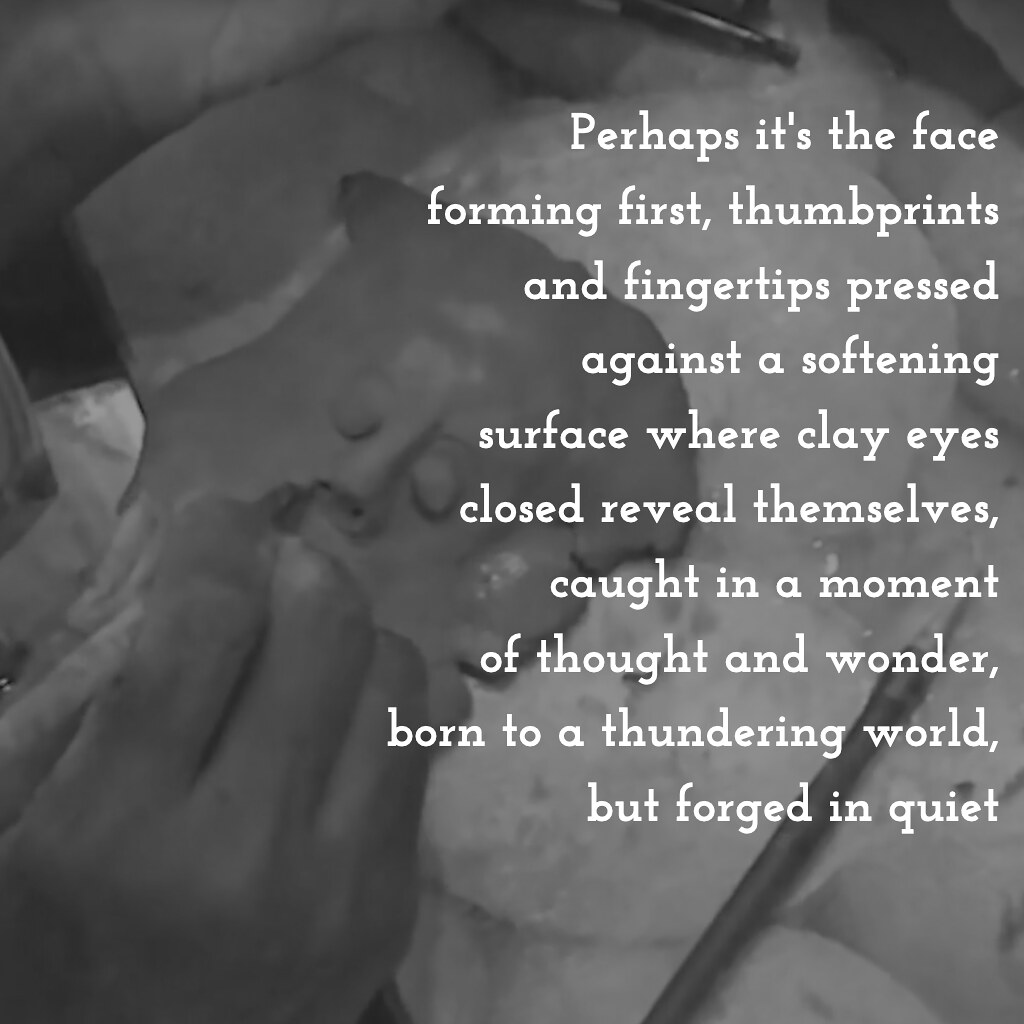
Poetry: Clay Face

Clay Face

Here’s another in a series of short poems inspired by the National Writing Project’s Baltimore stop for its Write Across America project. This poem is inspired by the clay sculpture work of Paula Whaley — learn more about her with this video.

Peace (smoothed out),
Kevin

NWP Write Across America: Baltimore

Home - Write Across America

The National Writing Project’s Write Across America place-based adventures continues into the school year, and I continue my practice of using the resources — when the resources get shared beyond the Zoom sessions that I nearly always miss — for some morning writing. This week, the project focused on artists in Baltimore, and it is a pretty fascinating collection.

Here are three poems (so far), inspired by three Baltimore artists and their work.

The first was from the work of Kathleen Fahey, who does old cranky-style videos, which are spooled stories that someone literally cranks to move along. Pretty cool and gives a story a forward motion.

A Tale Like This

The second poem came after exploring the work of Joyce Scott, who works with beads and glass and fabrics and more.

Beads

The third was focused on visual artist Ernest Shaw Jr., whose work is inspired by West African tradition and who does a variety of styles of art, including street murals. I listened to a video profile, taking notes on his words and then remixed his words into an art-themed poem.

In The Words of Ernest Shaw

Peace (in explorations of art),
Kevin