Good Trouble: Words From John Lewis

Heather Cox Richardson, in her newsletter, reminded me of these words from John Lewis, who wrote them one year before his death, five years ago, yesterday:

“Do not get lost in a sea of despair. Do not become bitter or hostile. Be hopeful, be optimistic. Never, ever be afraid to make some noise and get in good trouble, necessary trouble. We will find a way to make a way out of no way.” — John Lewis

If you have never read the graphic novel trilogy March, about John Lewis, you really should.

Peace (and hope, even in the eye of the storm),
Kevin

Book Review: Sunday Funday Wallace

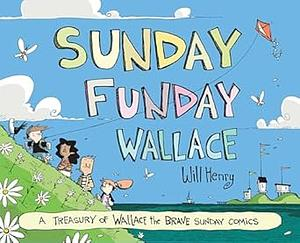
There is something very sweet about Will Henry’s Wallace The Brave comics — about a group of young friends who live in a fishing village community, with Wallace as the main character — and this collection of Sunday comics — which allow Henry to go big with color and space — is a masterclass in comics. Think Cul De Sac, or Calvin and Hobbes, but with a little gentler tone (although no less subversive) and with an expanded group of regular characters.

I recommend Sunday Funday Wallace to anyone who needs a break from the world. (Our local newspaper just recently started to run the daily Wallace The Brave comics and I am happy to see it every morning.)

Peace (in the panels),
Kevin

Book Review: Spring Rain (A Life Lived In Gardens)

Marc Hamer’s explorations of his life in Spring Rain is beautiful, scattered with childhood tension and rooted with adult understandings, and ultimately, love. I first came across Hamer with an earlier book of his — How To Catch A Mole — and I loved it for its language, and feeling, and compassion. And Hamer’s voice.

Life is infinitely creative — gardening is the same as painting, as writing, as dancing. The garden I made is this book; this book I wrote is a garden.” – Marc Hamer, Spring Rain, page 192

In Spring Rain, he explores two parts of life story — where he is now, in a loving relationship and connected to the soil after retirement as a gardener, and his difficult childhood, where he explains how his solitary personality and creative spirit runs afoul of his father, so much so that tension and thoughts of escape fill his early years.

That part of the story, his difficult and isolated childhood, is told in third person, giving some distance to the boy who came to love the wildness of the places he lived in and refused the rules of society. One early element of his story is that of an old shed, where Hamer spent much of his childhood (often to escape his father — called The Angry Dog in the book), particularly after discovering an old set of encyclopedias in the shed, books which open up the world to his young eyes.

Of course, Hamer is not just a gardener, but also a poet and writer and a visual artist, so his ability to craft splendid observations of the natural world, and our roles as humans within it, make for some eloquent and poetic sentences that can take your breath away.

He is at times very descriptive of how to attend to nature, in gardens and beyond, to encourage the wild of the world, and his philosophical take on what it means to be  traveler here is rooted in the Earth itself.

This body is not yours, it is nature’s. This mind that calls your body yours is not your mind, it belongs to nature. None of this is you or yours, it all nature expressing itself; there is no ‘you’ that is anything more than nature – nature singing its wonderful song. It breathes you into the world, and you are just a single breath. All things in nature arise, then fall: this is you. — Marc Hamer, Spring Rains, page 160

Hamer’s slim book is one that invites a slow, thoughtful reading. This is something my friend, Terry, taught me when I sent him my copy of How To Catch A Mole (because I thought of Terry as I read Hamer) and so I read Spring Rains in bits, over more time than I might normally have done, to let it sit with me.

And what bloomed, by the end, in Hamer’s garden was hope and acceptance, and love.

Peace (seeded in soil),
Kevin

Daily Create: Read Books

Read Books: Sign

The DS106 Daily Create is about what is our addiction (hopefully, not the kind that destroys your life). Mine is reading, and a love of books. I always have a few books going, and am always on the lookout for the next read(s). I use inter-library loan a lot, and sometimes, all of my books come at once, and then I am faced with a dilemma. Take them all, and let them sit for a bit, or give them back and try again at some future date (I often take that approach, figuring someone else might be waiting for the book, too).

You can find me keeping track of my reading at StoryGraph.

via GIPHY

Peace (on the pages),
Kevin

where once were poems

Surrenders at last to the visual

— page 166, Context Collapse (A Poem Containing A History Of Poetry)
by Ryan Ruby

No single word is worth
a thousand images – just
decompressed data files
filling space between air;
where once were poems,
there


This is the final installment of poems inspired by Ryan Ruby’s poem-essay book, Context Collapse.

Peace (in the space where poems once were),
Kevin

Wild Epigraphs: A Year Of Quotes From A Year In The Woods

I’ve recently read A Year In The Woods: Twelve Small Journeys Into Nature, by Torbjorn Ekelund, who tried to spend one overnight a month, for year, in the forest near where he lives. I enjoyed it, as a reflection on being a father and trying to reconnect to the wild places near him.

He called his overnights “micro-expeditions” because his hikes were short, and in close proximity, and he camped near the same spot each month, to notice the changes of the world on a manageable scale.

The book, told in twelve chapters, one for each month, fits nicely into this season of Write Out, which kicks off next week.

I appreciated the twelve Epigraphs that started each chapter, so I have gathered them here (August is the only one I shortened, because it was long and spilled over to two pages. I just used the ending here).

Peace (and explorations),
Kevin

Borrowed Lines: You Are Here

https://m.media-amazon.com/images/I/519nmgy+X-L._SY445_SX342_.jpg

A recent collection of poems, edited and curated by Ada Limon, inspired me to write some of my own poems, borrowing lines to build off. The original lines all come from poems in You Are Here: Poetry In The Natural World (edited by Ada Limon)


The sky is a century with no windows

from ‘To A Blossoming Saguaro’
by Eduardo C. Corral

—

lost count long ago
of how many rainstorms
arrived after you wandered
the windows left open, too,
time just dribbling in
with the wind, letting rotations
moisten the frame around which
the world might be watched,
one tear after the other year
until the canvas of sky
disappeared entirely


i’m sorry to the trees i grew up with

from ‘You Must Be Present’
by Jose Olivarez

–

I couldn’t find you now in the woods even if I tried
which sends me sad but maybe makes you glad
that this thief with a knife and a Sunday morning free
can’t add to the harm that was done to your skin,
the rough outline of a curved saxophone swallowed up
but for my dreaming, the protective sap that stuck
to the edge lip of the knife, how hard it was to wipe it off,
never closing tight ever again, like my eyes
in the remembering – the cut but not the place
where blood was drawn


make small steps.
in this wild place
there are signs of life
everywhere

from ‘Lullaby For The Grieving (at the Sipsey River)’
by Ashley M. Jones

–

slow go slow
this we know
but always forgotten –
that the wild places
wild spaces have stories
to tell, poems composed
beneath roots, reverberations
of a turning Earth, cursed
to forget the role of reader:
slow go slow
this we know


I only use words like stones because we are far away

from ‘Close-Knit Flower Sack’
by Cedar Sigo

We used to search
riverbeds and
shore lines
for the flattest of stone,
the thinnest of story,
just smoothed-out words,
in order to skip across
the surface as if
what we were saying was
lighter than air,
but no longer –
now we spend time
on the odd rocks
with strange angles,
the kind that makes
a distinct sound
one rarely forgets,
before plunging under
water


the moon mistaken
for a hole in the sky

from ‘If Fire’
Jake Skeets

–

fingers
in the stars,
then,

the galaxy,
a tapestry
of etchings

I’ve begun
to come
unwoven again

filling space
with words
and dreams


… the rivers

will set their stones and ribbons
at your door if only

you’ll let the world
soften you with its touching

from ‘Reasons To Live’
Ruth Awad

–

Raw sound bathes
the boy, the ripples
of river on stone,
he submerges himself,
nearly but not really,
alone, his mind, a million
miles from home


Thanks to all the poets who wrote and to Ada Limon for choosing and supporting those poems and poets.

Peace (in the natural world),
Kevin

Book Review: Poetry Comics

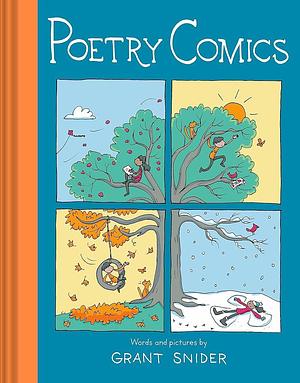
Poetry Comics by Grant Snider

Just in time for April and Poetry Month, Grant Snider’s new Poetry Comics book is a beautiful addition to the collection.

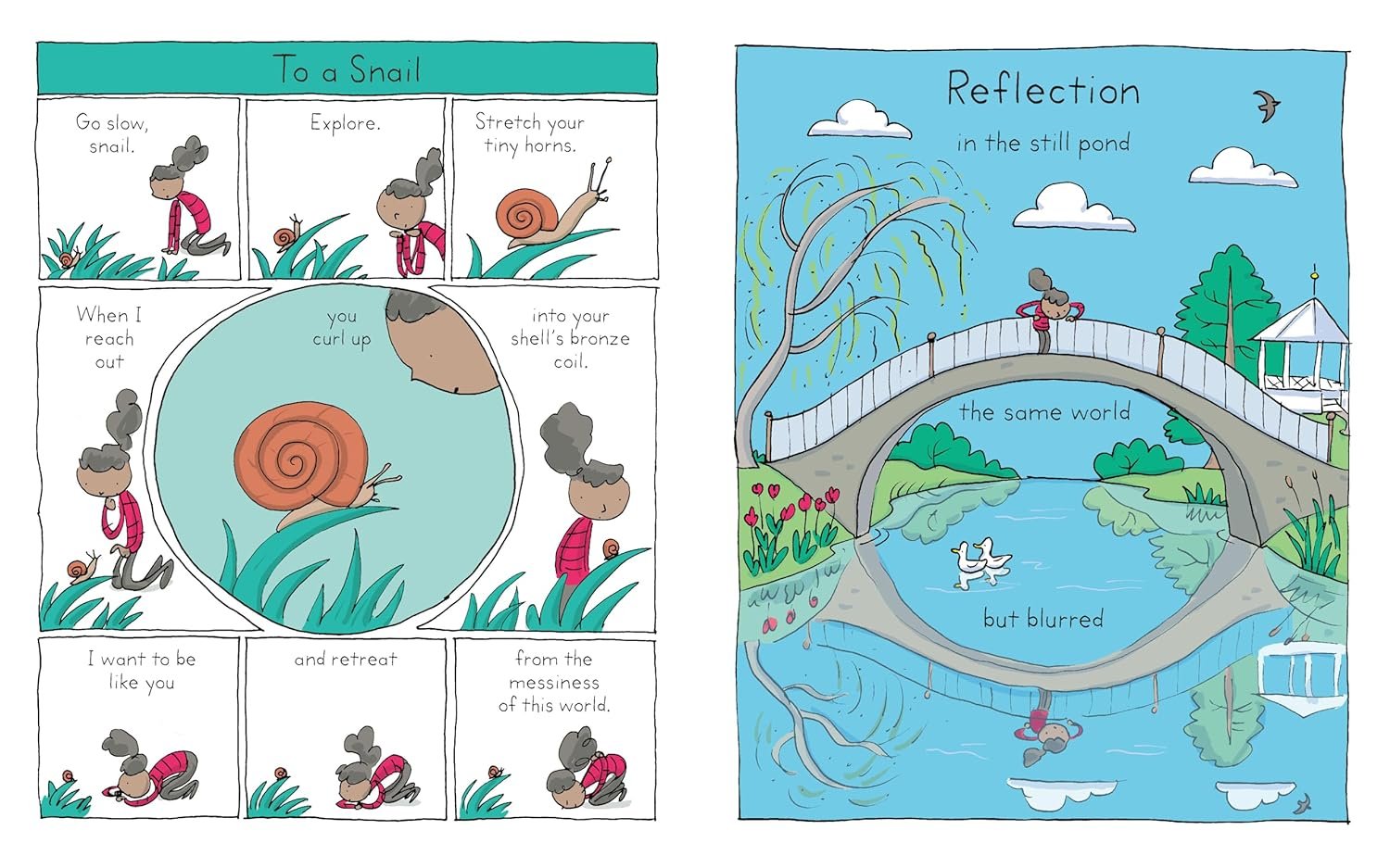
Grant gathers together four seasons worth of poems in the form of comics, in his own distinct style (literally – the book is divided into four seasons), and it’s lovely for the ways that he weaves in his illustrations, perspective viewpoints and a child-like view of the world. (This book is appropriate for any aged kid or adult).

Many of the comics are free-verse but he also uses rhyming patterns here and there, and haiku and other small form poetry styles. The book could be a useful resource in a classroom, particularly for students with an artistic bent and poetic reluctance.

81ITUbGYa0L._SL1500_.jpg

I also appreciate how many of the poems are about writing poems (something I am apt to do, too, with my own writing) in a way that looks at the creative process of writers and artists in a fun but thoughtful way. He even has a How To Write A Poem series sprinkled throughout the book.

Grant posts his comics regularly at his blog, too, and are always worth a look.

Peace (and poems),
Kevin