Bird Song: A Wood Thrush Composition

Wood Thrush Notation and Code

It seems as if my latest journey platform-jumping AI tools was always going to lead me here, to a place where I would “collaborate” with AI on the theme of bird song and music composition, and work to compose and record a piece of music using AI and my own musical skills.

Let me back up, in case you have not been following along with me over the last week or two. This is the fifth post in a series of inquiry dives where I am exploring various AI platforms on the theme of personal curiosity: how music composers have used bird songs to inspire music (sparked, in part, by Atlas Obscura’s newest book).

  • In the first post, I used Google’s Learn About platform to, well, learn more on the topic of bird song and music composers
  • In the second post, I took some information from Learn About and moved it into NotebookLM, and did more research and thinking
  • In the third post, I took the AI voice podcast generated in NotebookLM and cut it up, and remixed it, turning those synthetic voices into more of an audio collage with a repeating refrain
  • In my fourth post, I took ideas from that audio collage and asked Suno to write me a folk song

Which brings me here.

For this iteration, there were definitely more steps to take and more involvement on my part, as the human collaborator. I was really curious about how I might put some of the previous inquiry into action, by creating a piece of music that incorporated bird sounds but also with the help of AI collaboration.

The video down below is the result, but here are the steps to my mad process:

  • First, I went into Claude AI platform (my top choice these days, for its safety and privacy features, and relative transparency) and asked it to generate a piece of music manuscript inspired by the song of birds. Honestly, I didn’t think it would be able to generate anything useful for me. But, surprise, it did, and in fact, it generated an entire page of computer code that then became a short piece of musical manuscript.
  • Second, I realized that I wasn’t specific enough so I asked it to re-compose, with a Wood Thrush as its source. Again, it created a set of coded instructions that generated a few measures of musical notes, annotated with trills and slides and other bird-centered techniques, as far as I could tell. (see image at top of this post)
  • Third, I realized I had to find a way to play the notes, but as a bird, singing. So I went and found a downloadable file of Wood Thrush songs, and grabbed it. Then I took that file and went into Soundtrap (my go-to musical recording platform) and used its Sampler tool to create a Wood Thrush sound that I could use as a single note, so that every time I hit a keyboard note, it would sound like the Wood Thrush. Plus, I added some effects.
  • Fourth, I played the composition generated by Claude on my keyboard in Soundtrap, with the Wood Thrush as the sound generated by my playing as I read Claude’s manuscript. That was cool, but it still wasn’t enough.
  • Finally, I composed my own keyboard and synth background parts to complement the Wood Thrush song, and then layered in some more of the original bird audio, creating an audio tapestry of sorts that, I think, sounds pretty interesting.

And while the final piece is rather simple in its sound, it has a lot of complexities built into the process, and I see it as a creative intersection driven by my own interests, using AI as a collaborator and teacher at points along the way. It seems important to me that I ended up in a place where I was actually making something, instead of just having the algorithms spit results of queries out to me.

Peace (sounds like birds),
Kevin

Science Journal App: Tracking the Ups and Downs of Music

Setting up the Music Space

I’ve had Science Journal app on my phone (Android) for some time now, and every so often, I pull it out to play with it. But last night, as my new/old band began to play for the first time in over a year with a PA system and guitar amps (long story short: we lost our singer and bass player and practice space, went acoustic, found new practice space, looking for singer and bass player), I wondered what the sound levels were.

Right before we started our first song of the night in our new practice space — Love Potion Number 9 — I put the Science Journal app into motion, capturing and recording the decibel levels in the room. Yeah, it was loud. Our drummer has been waiting a long time to pound on his skins (as opposed to the electronic drums he has been using). He pounded away.


But it was neat to see the spikes of the song in Science Journal later on. I could see where the solos were, and where the song dipped into the break part, and more. I could see where the decibels clipped maybe a bit too high.

It made me wonder about that 85 db range that we hit. So I tracked down this chart. No wonder our lead guitar player wears special “in ear” plugs. We hit 737 sounds!

Science Journal is part of Google’s Making & Science initiative, which is pretty cool to check out.  You can read more about Science Journal (it even connects to Arduino? Cool) with this article.

Peace (it sounds like),
Kevin

Exploring Mobile Webmaker: i am small on the screen

Merely ... A Webmaker experiment

Mozilla’s pivot to mobile makes sense from its worldwide view and mission of connecting people around the world and giving them tools to “make the web.”  Most people in global communities use mobile devices, not desktop computers.

While I personally mourn the loss of Popcorn Maker (oh, I miss it terribly, and all of its remix media possibilities) and celebrate the new and improved Thimble tool (with file uploads and multiple page possibilities), I was sort of left out the mobile app experiment because I did not have an Android phone.

Now I do (long story, another day), and I went about exploring the free Webmaker App this weekend to see what Mozilla has been up to as it focuses in on mobile technology. I know the app is only the beginning (or so I think, as it seems in beta) and it wasn’t bad.

Nothing overly impressive yet, either, as far as I can tell, but I was able to make a website poem within minutes, and once I got myself situated, I found it fairly easy to use. I could see the threshold for using this app to be very low for most people. You can make the web within minutes.

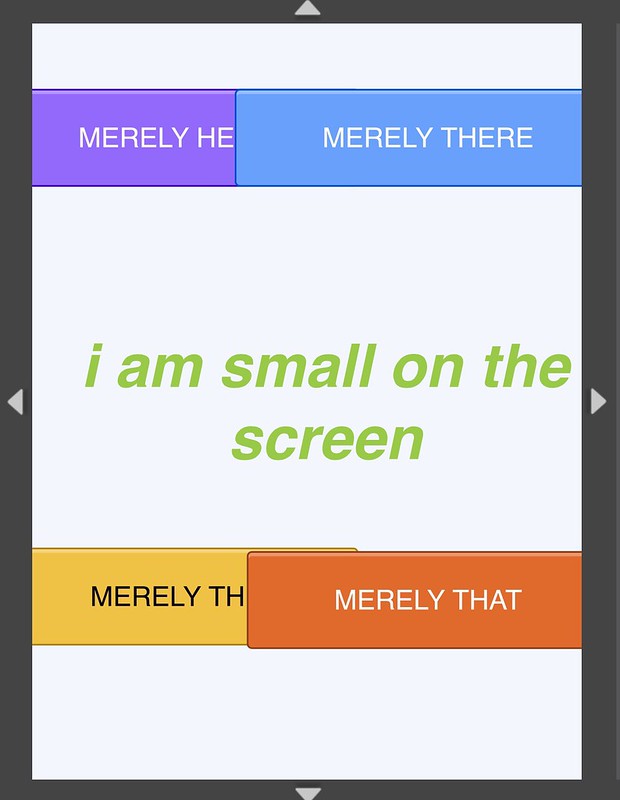
View i am small on the screen

I purposely did not include any images or graphics with my small poem, as I was trying to keep the design simple, with words and links to side stanzas broken off from the main trunk of the poem. Basically, the editing mode gives you branches to create multiple pages and buttons as links to those pages. The downside is that viewing of the finished project is best done in the app itself. On the web, the poem looks scrunched up, at best.

But maybe that claustrophobic effect is effective for a poem whose theme is the smallness of the web. I’m going to nod my head and say, that was my purpose as a writer all along. (You believe me, right?) The poem became digital within the constraints of the technology.

What will you make?

Peace (here),
Kevin

Webcomic: Waiting on the Download

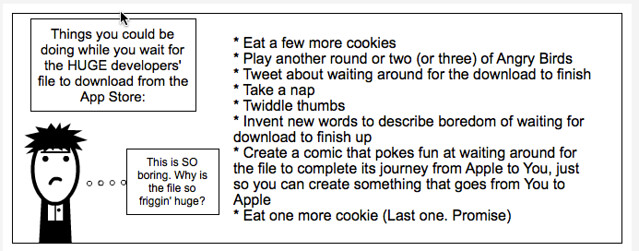
The download for XCode took quite some time for me (DSL, wireless, etc.) And at one point, the download got gummed up, so I had to restart my computer and restart the download again. (This time, I used an Ethernet cord, which was much faster). I need the XCode software to keep working on my App Development Adventure project. So, I created this comic ..

The Tweets App Development2

Peace (in the wait),
Kevin


Learning About IOS App Development

I’m going to be trying something new over the next few months. I am going to try to teach myself about IOS Apps and how to make them. I have no clear vision of how it will turn out, but my hope is that at least I get an understanding of how one goes about creating and publishing apps. I am going to document the journey with various reflections and, hopefully, some comics to poke fun at myself.

Here, I used an app called Telegami how appropriate) to set the stage:


I then used Vine to share the book I am using as my main resource:


And here is my longer video reflection:


But let’s not forget my comic, too, revisiting two former characters that I had created called The Tweets.
The Tweets: App Development1

Peace (in unexplored terrain),
Kevin