Upon Reflection: Reading Literature in a Digital Age

FutureLearn

I’ve long been intrigued by the ways in which technology is changing the ways (or not) we read and write. When someone mentioned a site called FutureLearn, and its free MOOC-like open course offerings, and a six week class called Reading Literature in a Digital Age, I was curious about the exploration.

So I dove in.

I’m glad I did.

Although some of the course material moved away from my main interest point, particularly as we explored modernity in Ezra Pound poetry, I kept finding my way back to the topic of digital reading in fascinating ways. The course mixed short video lectures by Professor Philipp Schweighauser (at the University of Babel), articles and inquiries, comments by participants and short quizzes of understanding.

WWWeb as Remediation Sponge

Here is a list of reading techniques we explored over the six weeks. Some I knew (but maybe with another name) and some I was only vaguely familiar with.

  • Hyper Reading (the way we scan digital text in an often non-linear fashion, seeking information that meets our needs)
  • Social Reading (annotating text with others in online spaces, so that the crowd understanding of a document can lead to a larger understanding of a text)
  • Close Reading (looking at the text and only the text, with very little context outside of what is on the page or the screen.)
  • Distant Reading (analyzing multiple texts with algorithms to determine patterns over time or central points that might be obscured by a closer look)
  • Surface Reading (examining the materiality of the text itself — the physical object — as well as all of the surrounding elements of the main text, such as title pages, copyright information, layout design, etc.)

At one point, we were asked to write a short essay on which of these reading strategies we most use, and I wrote this, thinking as much about my students as about myself as a writer:

These days, I am most attuned to the idea of “surface reading” because I am intrigued by the changes afoot in the world of literacies. The materiality of the “text” is an interesting notion, made even more so by the ways that we interact with screens in our daily lives (for good or for ill). As a teacher of young students, I am always struck by the disconnect between the literacies of our education system (paper-centric) and the literacies of their lives outside of school (screen-centric) and struggle with finding a bridge between the two. Therefore, paying close attention — “surface reading” — to how the materiality shapes our reading experiences, through media and through interactive elements and through access (or who does not have access) must become part of the conversations and considerations of expanded notions of literacy. I am also personally intrigued when discovering a new kind of text — who wrote it, who published it, how was it put together. Can I replicate it? With “surface reading”, I have an in-road to understanding the text in whatever form it might take. And if I can understand it, if I can peek beneath the covers to see how it works, maybe I can replicate it (remediate it?) myself as a writer, and then teach that new kind of writing/composing to my students, too. Giving them a chance to move from consumer to creator — sparking agency — is always my goal.

What the course reminded me of is how literacies is in the midst of a shift, and yet that shift is anchored in the traditional forms of texts in many ways. I appreciated the deep dives into various ways of looking at texts in various forms, and came out of the course with a better understanding of how researchers and lay readers approach texts in different ways, and seek different elements of understanding.

new media meets old media

I have now signed up for another course in a few weeks, called Teaching Literacy through Film. Wanna join me?

Peace (it’s in the text),
Kevin

What Diversion Sounds Like (Masters of War)

The other morning, I had my list of tasks to do. You know, writing and other things that I needed to get done. Then, along comes Simon on Twitter, referencing Bob Dylan’s Masters of War, with a call to remix or remediate or something, and there I am, remembering the day I bought Dylan’s vinyl Biograph box set and heard Masters of War for the first time on my headphones. I was 19 years old, just starting out with songwriting, and that box set became a bible of songcraft to me.

And Masters of War .. that one song haunted me for weeks on end. I could hear its words in my head at night when I slept and its phrasing crept into many of my songs that year, when I focused on writing political songs in the era of Reagan. I even wrote a song for a band that I just formed (our name was Behind Bars) that was an echo of Masters of War. Mine, about US intervention policy in Central America, was called Another War. (I am still digging around for a version of it).

So Simon reels me back in to that time period of my life, and I wondered if I could do a version of the Dylan song in Soundtrap and invite others to add to it.

My initial goal (now that my list of tasks for the morning was kaput) was to do something sparse with Dylan’s song and keep open musical space for others. An hour or two later, I realized I had set forth a version with tension and very little space for others but I could not find a way to remove sounds without messing with the urgency of what I was creating. Still, Ron came on board, adding the very interesting voice of emergency (This is NOT a drill) and some guitar riffs, and Bryan arrived later, with even more guitar flourishes.

The invite to others is still open. We’ll see what happens.

Peace (it sounds nothing like War),
Kevin

PS – this version of Masters of War by Ed Sheeran is a new favorite of mine.

Writing with Light: I Fear I Left the Poem Behind

I fear I left the poem behind

I was reading the Sunday newspaper, when I came upon an interview with a writer who has published a new book about the history of computer Word Processors. The writer is Mathew Kirschenbaum and his book is Track Changes: A Literary History of Word Processing.

The conversation was interesting (including one point where he found historical references to writing on the screen as “writing with light” — that stuck with me and became ‘refolding these pockets of light’ in the poem), as it centered on the ways early Word Processing programs changed the way some people write (or at least, the perceptions of the writing process).

The interview references a famous quote by Joan Didion about how writing is a bit like sculpture, and a writer chips away to create form. Didion was referring to creative non-fiction writing from the strands of inquiry and research, I am sure, but I starting thinking of poetry in context to her insight, and how space and inference play a part in writing poetry. What you leave out is as important as what you leave in.

Writing nonfiction is more like sculpture, a matter of shaping the research into the finished thing. - Joan Didion

I’ve seen the Didion quote before but something about it, in context to the discussion about digital writing, stuck with me for the day, and that led to the poem above, called I Fear I Left the Poem Behind.

Peace (with hammers and chisels),
Kevin

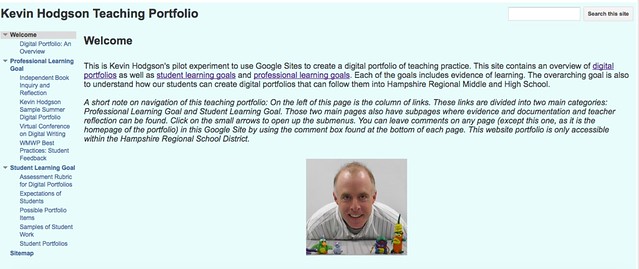
At Middleweb: Digital Portfolios (teacher edition)


Kevin professional digital portfolio

In my latest blog post at Middleweb, I explore the potential of digital portfolios for teachers. (My follow-up in a few weeks will focus on how my students are creating their own digital writing portfolios as the school year comes to a close). Here, I explore my own shift towards a digital teaching portfolio as home for evidence and reflection for my educator evaluation process.

Check out: Exploring the Potential of Digital Portfolios

Peace (port it),
Kevin

Blackout Poems: Name Recognition

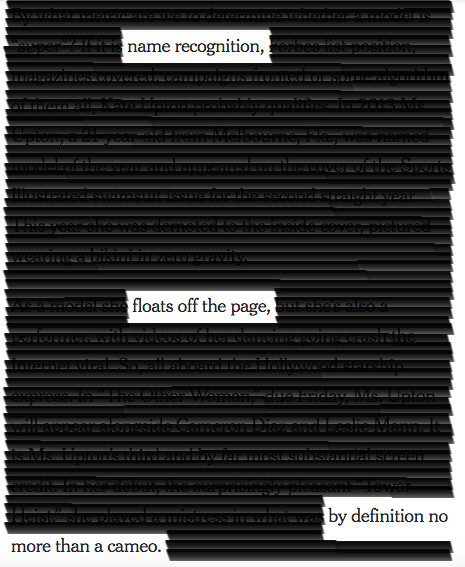
(I am using the New York Times interactive Blackout Poetry site for a few days to create Blackout poems. They give you some articles to choose from. You create poems of no more than 15 words. The interactive does the blacking out around your chosen words. It’s pretty cool. You can also read other poems built around the same articles. Give it a try.)

Blackout Poetry1

Process Note: This poem is created from an article about model Kate Upton and her attempt to move into acting. It’s also about what beauty is in the age of viral images. In this poem, I tried to keep my attention on the recognition of name in pop culture, and the transient nature of likes and thumbs-ups and more. That “no more than a cameo” is a good line. I also liked the floating off the page concept.

Peace (in what’s unsaid),
Kevin

Immersed in the Music: Jeff Buckley, Bob Dylan and You


This is a pretty amazing use of video technology by the team that continues to share out the late Jeff Buckley’s music. They have used Buckley’s cover of a Dylan song (Just Like a Woman), and made an interactive watching/listening experience for the viewer/listener — transforming the song and interpretation by Buckley into something magical. Not to mention with sexdecillion combinations (according to the producers .. I didn’t count).

They say:

All together there are over 16,000 different music combinations that can be created. The video contains 73 different animated cells that can be clicked or tapped to alter the story, adding up to a staggering number of possible visual and story combinations: approximately 1 sexdecillion. That’s a 1 followed by 51 zeros.

Throughout the song, you can click on small images which change the ‘story’ of the song, as Buckley’s amazing voice and single guitar guide you through, and then a few minutes in, they start sprinkling remix options, where choosing various paths add new layers to the track you are listening to at that moment. Strings get added or removed. A guitar run comes into play. Keyboards move up in the mix.

Wow.

I found myself deep inside Buckley’s voice here. I worried that the immersion in the video might distract me from the song and the singing. Maybe it is because I already know the song. Maybe it is because I already know Buckley’s voice. But the combination of listening and exploring combined for me into a satisfying experience all around.

Play/Listen/Remix/Enjoy

And now the question that comes to my mind? How did they do it? I want to see a “behind the scenes” video of how this all came to be created? I want to learn about the process and wonder about how one might even venture forward this way? I wonder how this might be viewed and taught as ‘writing’ in the digital age.

Peace (in the Muse),
Kevin

Make Your Political Voice Heard: Annotation Nation

Annotation Nation

Here is another example of the “long arm of the CLMOOC” — Terry Elliott and Joe Dillon are launching an impromptu Pop-Up Make Cycle this week that invites everyone and anyone to join in the annotation of political pieces about the volatile and unpredictable American presidential race. Joe and Terry are selecting some articles to mark up, but you and I can share out our own pieces, too, and invite others to annotate along with us.

For example, I have been tinkering with this one about the role of Independent voters, via Medium. This link will bring you to the annotation overlay.

How will the crowd-annotation work? Many of us have been playing with the Hypothesis add-on tool for some time, and we find it has a lot of value for crowd-sourced annotation (along with some drawbacks around visibility). It allows you to layer on comments and media into the margins of the article. Whole conversations can unfold as another layer on the web.

But there are other ways to annotate — you could write a blog post about something you have read and share the link; you could use the Diigo bookmarking site, which also allows you to crowd-annotate articles within the Diigo environment and kicks out a shared link; or you might just want to remix articles in your own fashion. If you know anything about CLMOOC, you know you do what speaks to your own interests.

Here is one example of Hypothesis and a shared annotated text.

Annotate This

Or, if folks use the “CLMOOC” tag in Hypothesis, we can view all of our shared annotations together in one stream. Check out what I mean.

We are all part of the Annotation Nation now. Come join Terry and Joe and the rest of us. Make your voice heard, even if it is in the margins. You can use the #CLMOOC hashtag on Twitter or share in the CLMOOC G+ Community. Make a video. Create meme or GIF. Do what you want. Take part in the Make with Me live session on Google Hangout that Terry and Joe are planning for Tuesday night (tomorrow) at 7 p.m. EST.

Margins come alive

Peace (so we can make change),
Kevin

Just Let Me Wander


flickr photo shared by pdinnen under a Creative Commons ( BY-SA ) license

I’ve been working behind the scenes to test-drive something related to student writing. It’s been an interesting experience in which the designers have done a solid job, but I have (perhaps wrongly) sensed some tension about how a developer wants to introduce their work to someone like myself, who wants to jump right in.

I am, admittedly, a diver.

I would rather know nearly nothing about a tool or technology before jumping in. Let me figure it out on my own terms. Allow me my disorientation. Let me push up against what you think a user might do. Let me discover workarounds when I find a wall. Let me get frustrated, if I need to. Let me ask for help, if necessary.

Let me explore and wander.


flickr photo shared by @artnabart under a Creative Commons ( BY-SA ) license

Now, I am not a software designer, so I can only imagine the other side of this coin. Imagine spending countless hours, creating an experience, and no doubt, you’d want to share what you have put into play. You’d want outside voices to validate the work and you’d probably want want to point the visitor to places where you know there might be issues. You’d always want to demonstrate what works.

A designer probably desires so much to be a tour guide, showcasing and highlighting the wonders of discovery. They want to share their expertise and experience, and let a new user see the unknown through their eyes.

But more often than not, I don’t need that kind of guide and prefer to be without one. Just give me a map with some faint outlines, and some murky unknown terrain. Maybe a compass. Some snacks. If the design is done right, I should not need a guide at all. I’ll send back messages in a bottle.

There be dragons here … but just let me wander anyway.


flickr photo shared by thornet_ under a Creative Commons ( BY-SA ) license

And this story, while based in some real experiences, of mine is really me, thinking about the learners in our classrooms, right? If I give my students the entire tour, showing all the nooks and crannies of the learning experience, have they really learned the experience? Have they experienced the experience? As teachers, we are designers, too. Set the path in motion and let them wander. Even, let them get lost once in a while.

Peace (in the midst of it),
Kevin