Slice of Life: Poetry, Code and Creativity

(This is for the Slice of Life challenge, hosted by Two Writing Teachers. We write on Tuesdays about the small moments in the larger perspective … or is that the larger perspective in the smaller moments? You write, too.)

This week, I will set aside some time for my students to explore Hour of Code, connecting the creative play there with the work we are doing around storytelling and video game design.

Each year, I keep an eye on any new activities in the Hour of Code. This year, the newly added activity is all about poetry and art and design, and that connection between exploring verse and basic programming makes me happy to see.

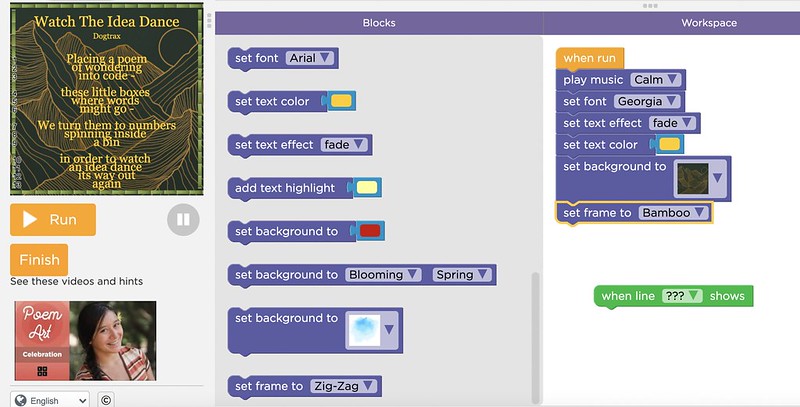
The Poem Art activity — introduced via video by a high school poet and programmer — allows students to explore animation and text manipulation, as well as design and music and mood. There are options for using provided poems (such as Jabberwocky), but also a place to write your own poem and use your own words.

Cool.

I tried it out by writing a poem — Watch the Idea Dance — and thought it worked just fine.
Hour of Code Poetry

Take a peek at my poem.

Then, maybe make your own.Peace

I’ll be bringing this, along with some other activities, to my sixth graders tomorrow.

Peace (coded for the world),
Kevin

Slice of Life: Gearing Up for Video Game Design

(This is for the Slice of Life challenge, hosted by Two Writing Teachers. We write on Tuesdays about the small moments in the larger perspective … or is that the larger perspective in the smaller moments? You write, too.)

The weeks after Thanksgiving are often the time when I introduce a unit around “non-traditional writing” where my sixth graders explore Interactive Fiction texts and writing (just wrapping up) and move into Video Game Design with Gamestar Mechanic.

Librarian's Quest: Let The Gaming Begin!

Alas, Gamestar pulled the plug on its online site due to the end of Flash software in browsers but, phew, launched a stand-alone app for Macs and PCs (but not Chromebooks) that remains a robust place for learning about game design and an opportunity for young people to tell stories through design principles.

Today, I am going to walk my students through the various steps of accessing the app on their school Mac laptops, launching the app, registering an account within my special classroom space in Gamestar, and begin exploring the site before I start to introduce the “story” they will be “writing” as a video game project.

Gamestar Mechanic - Educational Game Review

This particular cohort of kids is tricky. They get antsy. They focus on other things. They jump ahead. I’m going to remind myself to be patient today as I work to get 60-ish sixth graders up and running, and playing games.

Wish me luck.

🙂

Peace (playing it forward),
Kevin

Slice of Life: Let’s Not Go There

(This is for the Slice of Life challenge, hosted by Two Writing Teachers. We write on Tuesdays about the small moments in the larger perspective … or is that the larger perspective in the smaller moments? You write, too.)

I teach in a fairly conservative town in the midst of a very progressive part of Massachusetts. Sometimes, that tension becomes visible. Like yesterday …

My sixth graders are working on Interactive Fiction stories and one student, louder than they needed to sound, asked if it was OK if one of the characters in their stories shouts out: Let’s Go, Brandon. (If you don’t know what that is, you need to look it up).

To which I not only shook my head in an exasperated “no,” but then launched into a response about how I know exactly what they are trying to do by asking the question, and no, that would not be allowable in their story. (Although part me wonders about free speech and all that …)

Later, as we were walking from our class to the next, outside for fresh air, this same student shouted that phrase out loud.

Sigh.

I took them aside, and now went into my full speech about respecting the presidency, whomever is in office and whatever your political views, and I reminded them of how I served in the military myself and I believe in level of respect and expect them to, as well, and we left it at that.

I know they are using the term because it seems furtive and a way to get a reaction out of friends, and probably, it’s something they are hearing at home from either family or the conservative news channels that the family is watching, or it’s something they are seeing on YouTube or other social media, or perhaps it’s some mix of all those things.

It’s another reminder how words matter, and how the level of discourse in our country has reached yet another low point, and how sad that is that echoes of it has come into our sixth grade classrooms.

Peace (respectfully),
Kevin

Visualizing a Relationship with Technology (The Internet Mapping Project)

Internet Mapping Oct2021Each year, we begin a unit called Digital Lives, I have my students take part in Kevin Kelly’s old Internet Mapping Project, with the prompt: visualize yourself in relation to technology (devices, Internet, etc.). I am always intrigued and amazed at how inventive my sixth graders are, and how these drawings spark some very interesting discussions in class about technology and our lives.

Peace (drawing it out),
Kevin


#WriteOut Park Ranger Writing Prompts Map

Ranger Writing Prompts for Write Out

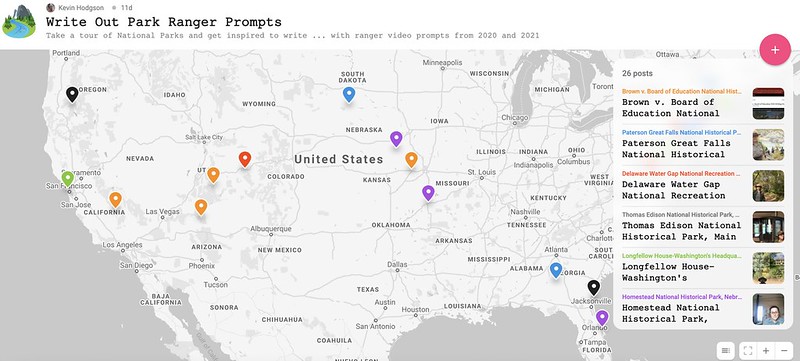
If you missed any of the National Park Ranger prompts from Write Out this year, or last, I have gathered most of them together onto a Padlet Map. I like the visual, showing links across the country to the various National Park sites where rangers have participated. We used quite a few in my sixth grade classroom to spark inquiry and writing.

Check it out

Made with Padlet

And remember, all resources with Write Out remain available, even though the official two weeks are now over. It’s always a good time to write out.

Peace (on the map),
Kevin

WriteOut: Making Tree Maps

For one of our last activities for Write Out, I took my sixth grade students outside the school building for a long walk around the perimeter of the property. Notebooks in hand, their task was simple: count the trees by making a tree map of the school property. We first watched the video (above) to explore the effort that had gone in to trying to tally how many trees are in the world (and to look at the very cool mapping project).

We counted about 40 trees on the main property of our school (not including the trees lines of the property border) and in doing so, my students really “noticed” the trees for the first time, asking about the varieties of trees, and why one stretch of seven trees was planted in a single file, and why did the Weeping Cherry appear like a bush, and I explained how a group of students planted some of the trees on the playground years ago to create shade for future students (now, there is shady areas, which the current students enjoy).

We also watched this Park Ranger video from last year, about trees and roots and Sequoias:

The Tree Map activity was pretty simple — the video of the world’s trees sparked high interest in what was right outside our window, and any opportunity to go for a writing walk on a beautiful New England Autumn day is always worth it.

Peace (planted),
Kevin

We Wrote Out for #Writeout

WroteOut for WriteoutI’ve been using Daily Sparks (video writing prompts from National Park Rangers) from Write Out each day with my students to write our way into our day.

They have enjoyed the videos that share the view of the Grand Canyon and time’s impact on our planet; the exploration of engineering at the Springfield Armory with the Blanchard Lathe (with a video in English and a video in Haitan Creole, which fascinated my sixth graders); and yesterday, they learned about George Washington Carver (most of my students didn’t know a thing about him, so it provided me an opportunity for a mini-lesson on this amazing Black scientist and innovator) before we headed outside to write.

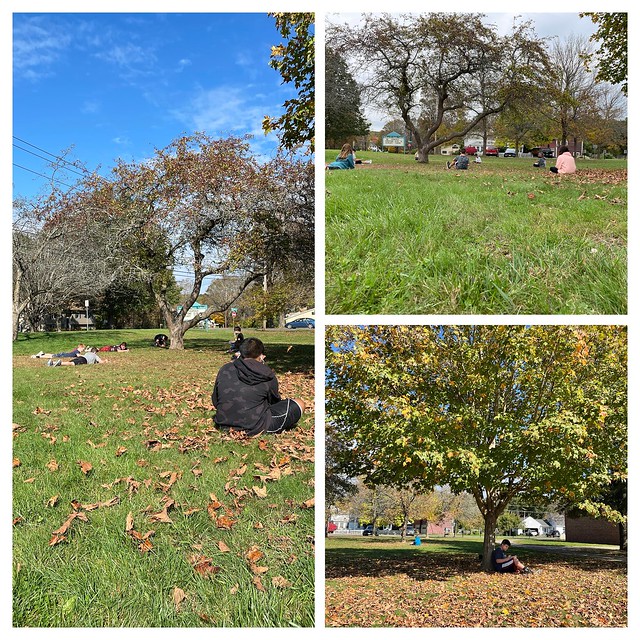
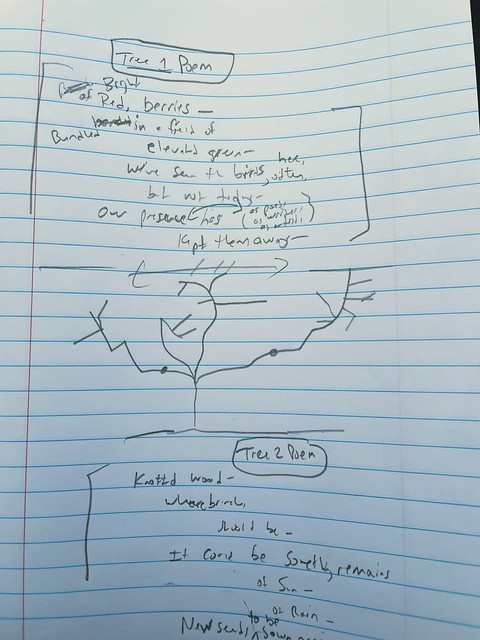
It was a beautiful day, perfect for finding a place to write and make art. My variation of the prompt from the ranger about making an art journal was to choose one of the trees on our school lawn, and use it for inspiration for a story, or poem, or letter, or comic, or art.

I wrote, too.

Tree poem sketches

It took a few minutes for them to find the quiet they needed for the activity, but once we were settled in, they enjoyed the change of location for our writing activities, and were able to be mask-free writers for a bit of time (always a bonus).

After some sharing, we moved on to our other lessons, but this slight reprieve in the outdoors air with our writing notebooks was just the break that we needed on a Friday to remind ourselves that writing out can be as simple as stepping outside the school or home, and finding a place to sit and observe and become inspired.

Peace (sharing it).,
Kevin

Slice of Life: A Game of Hide the Water Bottle

(This is for the Slice of Life challenge, hosted by Two Writing Teachers. We write on Tuesdays about the small moments in the larger perspective … or is that the larger perspective in the smaller moments? You write, too.)

Sometimes, I just watch to see what my students will do in the time between learning. It’s always fascinating. In other years, this is how I first learned about Minecraft, and heard about Visco Girls, and watched students show me the Mannequin Challenge, and was taught in detail about dance moves on Tik Tok, and more.

This year, I’ve been observing a gaggle of my most energetic boys play a game in which they hide each other’s water bottles in the classroom. They play it voluntarily and I have not noticed them bothering anyone else’s water bottles. Here’s how they do it: one boy turns his back or goes into the hallway, and the others scheme inventive places to hide it. The owner returns and tries to find it, and the others give hints, if needed.

At this point, they are running out of new places to hide things in the classroom, but I’ve observed them put it behind books in the bookcase, inside a tube of rolled paper that I have, behind our class mailboxes, below the old mounted television set, buried in a box of colored pencils, stuffed under tables and desks, and more. They get very excited when they find a new hiding spot.

They tell me they have been playing versions of this game for years, which I find rather amusing, and as long as it doesn’t get out of hand and as long they are not bothering anyone else, I am content to keep them engaged in their playful game, and see where the water bottles will go next.

Peace (and play),
Kevin