Thinking On Stranger Things

The rest of my family gave up years ago on Stranger Things but I felt myself committed to seeing how the story ends. Even though at times, the Duffer Brothers‘ series got pretty confusing and chaotic over the decade of watching, I always found myself interested in how the pieces were coming together. And the focus on the characters over time kept the series grounded as a narrative, to me. (I know plenty of people have their criticisms).

This last season had its confusing plot elements midway through, for sure, as the Duffer Brothers brought back together every single significant character to the finale and tried to dig into depth on the character of Henry, so we would understand him (the final cave dream scene is quite dramatic). So, there were lots of characters to keep track of, particularly when they went off on different missions. Too many characters, in any normal story-line, but it made sense for Stranger Things to do this, so that the various threads over the last ten years could have some resolution.

I have a colleague who also kept watching over time, so she and I have had our down little Stranger Things discussions among ourselves. I didn’t feel completely alone, anyway, as a viewer. And I noticed that when Season 5 dropped over Thanksgiving, many of my sixth grade students were suddenly watching the first season and talking about the characters. Honestly, though, I am not sure that Stranger Things is appropriate for 11 year olds, particularly in the later seasons (language and violence, along with grappling with sexual identity).

But it is odd to think they were just a year old when the first season launched on Netflix.

The finale was two hours long and I appreciated that the Duffer Brothers took their time to resolve the characters stories at the very end. It all felt emotionally right to me (even with the one mystery possibility suggested by Mike at the end) and the use of the friends’ Dungeons And Dragons game at the end was a circular connector back to the very first episode in the first season, and how the whole story got started. Using old footage from earlier seasons in the finale was quite emotionally effective, I thought.

My youngest son, who lost interest years ago (“it was always the same story, told every season”), asked me if the Duffers left it open for a sequel. Maybe. I hope not. I believe Netflix has something in the works for a story adjacent to the world of Stranger Things but I am not sure what it is — maybe an animated series?

I am not interested. (Nor am I the audience for it).

But I am interested to see what the Duffer Brothers come up with in the future (elsewhere, as they are no longer connected with Netflix). I appreciated that they knew how to tell an epic story by focusing on characters. The Wikipedia site for the show has lots of interesting elements, including the first iterations of the story.

Peace (at the end),
Kevin

Hero Camp Documentary: Immersive Storytelling At Its Finest

Colin and Sam: Hero Camp Documentary

My eldest son, Colin, has worked with his friend and fellow filmmaker, Sam, on a full length feature movie documentary about a summer camp called Story School in central Massachusetts where LARP (Live Action Role Play) allows young people to not only immerse in story, but also to be comfortable with their identities in a safe environment.

The movie is called Hero Camp, and last night, my wife and I finally saw the movie, as it was shown to a packed house at the camp itself. We’ve heard much about the project for the past two years, but had not seen any of it until last night, and we loved it (OK, I know our son was the editor and co-producer, but still ….).

You can see the trailer for the film here: Hero Camp

Colin and Sam really captured the spirit of three of the campers at different times in their lives, as they all grappled with difficult and important issues. And the filming was beautiful.

The documentary premiered a few weeks ago at the Seattle Film Festival and Sam and Colin are trying to get it into other festivals, as well, in hopes it might get picked up by some distributors.

Peace (and feeling proud),
Kevin

Movies On The Page: Internet Archive Remix

My DS106 friend, Paul B, shared a call from the Internet Archive, inviting people to use material from 1927 — now entering the Public Domain — for creative remix for a contest with cash awards. I sent the invite along to two of my sons who are filmmakers and then thought, What about me? (And what about you? See the Internet Archive blog post with all the information)

I dove in and came up with idea of using a 1927 periodical’s front page as a series of movie screens for clips from animated movies from the 1927 collection. I was hoping for something more narrative cohesive, but I ran out of time and patience and technical know-how.

I still like how the project came out, though, with little screens on the page, and clips from the movies showing. And the other entries coming into the contest are pretty cool. Check out the page where the projects are tagged.

Peace (and remix),
Kevin

Why The End Is So Important (or, sitting through the movie credits with kids)

The last few years, I’ve noticed a clear trend with my sons when we go to watch movies, on the big screen in the theater or even on video. There’s a heightened interest in the post-credit video teasers. I’ve sat through more endless credit texts than ever (which, I suppose, is a good thing, to acknowledge how many people are working on so many aspects of a movie) just to see 30 seconds or so of video.

The other night, my son and I watched the Wolverine movie, Logan, and he was determined to see if there was a post-scene video on the disc, and then searched online afterwards, even though the movie is a few years old now and any post-credit scene would have already unfolded and long been outdated (perhaps this is what intrigued him most .. making the connections between what is teased and what really unfolds).

It was the Marvel universe who ramped up this phenomenon (see this listing of post-credit scenes in Marvel Universe), but now, I notice that my sons and my students often expect something on the screen, after the story has ended and the credits are rolling. They chat among themselves — in person and on social media — more about those small videos than about the larger movie, sometimes. There’s even a full website devoted to this concept (well, of course there is … probably many of them).

Which had me wondering about the draw of this.

First of all, from a movie production standpoint, this trend has to be viewed as a success. The movie companies get us to sit through the credits, and they get to promo some upcoming movie. Of course, they have to it with style and inference, and that “What?” quality to pique the interest.

From a viewer/fan standpoint, the viewing of the post-credit videos gives some cultural cache (I stayed to watch, did you?) and has some of the Easter Egg qualities that are dug deep into the modern digital media world (I found it, did you?).

It used to be that my boys (who have made their own films) and students all wanted to make bloopers whenever we made videos — in fact, they wanted to elevate the blooper to the forefront, right from the start, scripting blooper moments instead of capturing mistakes as they happened. Now, these post-credit scenes seems to have mostly replaced the blooper reel.

I guess what I find intriguing about all of this is the elevation of these scenes to equal status of the movie itself. Perhaps it speaks more to our attention spans (the videos are short, although you do need to sit for some time to get to them) than anything else, and feeds nicely into the YouTube viewing habits.

Peace (following the credits),
Kevin

Writing Myself In a Corner: Write and Record a Song (in 24 hours)

song under construction

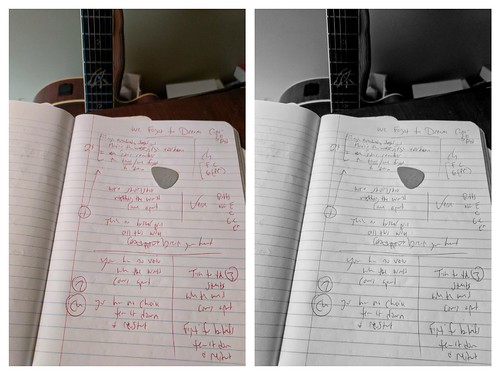
Sometimes, when I hit a bit of a creative wall, I challenge myself to just go on and do something. Write that poem. Start that story. Write a song. On Sunday afternoon, I decided I wanted to see if I could write and record a demo of a new song, all within 24 hours. With that impetus, I got to work, huddling over my guitar and notebook paper, scribbling and scratching out lines as a phrase “we forgot to dream” became the hook.

I knew the song would be inspired by the recent elections, but I didn’t want it to be an overt political song. More like a reminder that even when things take turns to the worst, there is always some hope for change. And that there have been difficult times before. We made our way forward then. We can do it, again. It won’t be easy. It never is. But we can do it. This was the theme I was working towards.

I do get a bit obsessive when writing a song. Sort of a hermit in the house, riffing the same chords over and over on guitar (my poor family) as I work on rhymes and meaning, and structure. I revamp and re-arrange words and phrases and verses and choruses, and then I walk away from the guitar and paper, silently singing lines in my head, remixing rhythms. I wander the house and the rest of the day like some madman, whispering poems to himself.

Late Sunday night, I went back to the work on the song and hit a wall. I found that I had forgotten the basic rhythm of the song from earlier in the day. In fact, I got so frustrated with myself (one, for forgetting what I had written, and two, for not doing a quick raw demo when I first started, which I often do, as a listening post) that I had to walk away and call the songwriting challenge quits.

By morning, my mind have found the threads again, though, and began weaving me back to the song. Thank you, sleep. When I picked up the guitar yesterday morning, the phrases all clicked into place again, as easy as you can imagine, as if I had never stepped away from the song at all. I can’t explain that process. It’s a strange and wonderful mystery.

So I set to work on recording what I had written. First, I began by finding a beat, and then I went about recording the guitar, and then, the vocals. Oh, these vocals. I don’t like the way I sing this song at all. It’s a bad key, or something. But I never really like my vocals. I worked to add effects, to give the voice a silo-like, garage effect. Bleh. Still, I kept moving forward with the recording, finishing the voice, and then adding percussion and then topping it off with some guitar power chords.

A little after 24 hours after I was done, the demo of the song, entitled “We Forgot to Dream” was done. For now.

Peace (sounds like power chords),
Kevin

Inspired to Spoof: My Son’s Video Project

My son often makes videos. He has written and shot three longer movies with a group of neighborhood friends (all by the age of 11), had one of the movies showcased in our city’s Youth Film Festival and has done a variety of smaller films, too. Long ago, I showed him what I knew about iMovie (and he took part in a free Apple camp at the Apple Store to learn about video), and turned him loose.

He recently finished this short video (he is now 12). My only role was to hold the camera so that he and his friend could be the actors in it. They first researched the ideas from a site called Dude Perfect, which I was only vaguely aware of. But they loved some video that spoofed baseball players, so they, eh, remixed the Dude Perfect ideas into their own spoof video of baseball players (both kids are baseball nuts).

What struck me is this.

Rally Cap Kids

They sat down, together, with a pad of paper and pencils, and watched Dude Perfect videos, and made detailed notes about different “stereotypes of baseball players,” knowing they were going to riff off those movies for their video. They brought the notes to the baseball field, and talked through each scene, before instructing me to shoot the video. I tried to keep as quiet as I could. I was only the camera man.

I love seeing the development of a craft here, and I hope he keeps doing it. When he does a longer movie, it takes a lot longer to shoot and edit. These smaller projects are more manageable, and I think he has a talent (says his dad) in making videos. I know he has fun with being creative this way.

Peace (frame it, capture it),
Kevin

At This Camp, Movies Get Made

Making Movies at Camp

My youngest son attended a day camp all last week, writing and shooting and editing and producing short films over five days. on Friday, family members were invited in to watch the results, and the movies were not only entertaining, but pretty well done, given constraints (of locations and time and props). The camp, at a local Montessori School, borrowed high-quality video cameras from the local Cable Access Station (which will showcase the short films on its television channel and online sites). You can see the difference — the video is rich and professional grade quality.

The camp facilitators let the kids do all of the heavy lifting — writing the scripts, setting up the cameras, and editing with iMovie. My son has done most of these things before — he loves to make his own movies — but it was nice to have him in a group, working with other kids and being creative. I don’t think he wrote all that much, though, which is too bad.

There were three short narrative films (including one very intense one about a puppet and a cruel puppeteer that had the audience in silent wonder) and a few music videos, most using Green Screen effects. Later, the videos will be hosted online. I’ll share out when that happens, in case you are interested in what kids can do with cameras and iMovie and imagination.

Peace (from small screen to real life),
Kevin