Feeding A Poem Into An AI Art Machine

Haiku (with AI Art)

Like many, I’ve been thinking closely about the kinds of text prompts I am using with Generative AI models like Bard and ChatGPT and Dall-E and Firefly.

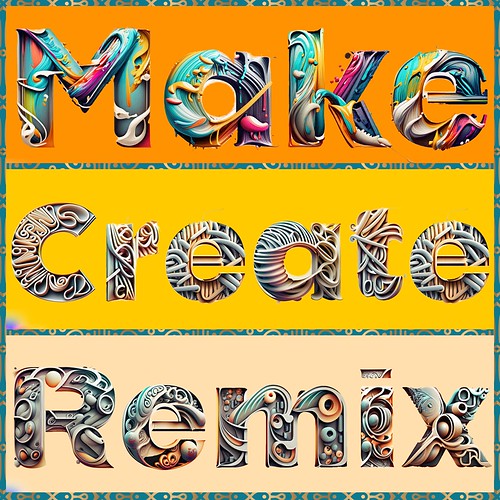
This morning, as I was working on a SmallPoem — in this case, a haiku inspired by the long day of rain yesterday that was desperately needed — I decided to feed the entire haiku into the new Firefly art site, and see what it would design. Firefly works like Dall-e in many ways — you add text and it generates image — but it has many more bells and whistles for artistic design that I am still exploring. What it doesn’t have that Dall-e does (and which I like) is the “variation” button that re-creates the art in different ways. But Firefly does generate four images for each prompt, so there are choices.

I designed many variations and then chose four that I liked best, and moved them into a photo collage maker, and layered the haiku on top. I think it looks interesting, although I am not sure the images created by Firefly gave me anything too surprising, which is too bad, since I was hoping the poem as text might bend me in another direction. It seems to be that the site got focused on the words “rain” and “prayer.”

Peace (and Art),
Kevin

AI Thinking Partners: With Or Without You?

My friend, Terry Elliott, shared this poem, coming on the heels of his explorations of AI Thinking Partners in the NowComment annotation space. I haven’t yet ventured into the new features in NowComment (but I intend to when I get more time), but I think the concept of human writers intentionally paired with Generative AI “partners” (like ChatGPT or Bard) for thinking, planning, writing, and more is gaining a foothold in the broader AI communities, particularly in the educational circles that I am part of (like ETMOOC2).

This idea decreases the zero sum game of “write my essay or report for me, AI” for copy/paste/plagiarism that so many of us are concerned about, where the writer does little more than prompt a final response from the platform, and then is done. An AI Thinking Partner potentially engages the writer into conversation about a topic, providing information, possibly outlines for longer pieces and maybe revision suggestions, too.

As we often do, I wrote a poetic response to Terry’s poem, as sort of a push-back to the message that the future may require this kind of AI interaction of writers, and I tried to remind myself of the beauty of drafting a piece of writing on physical paper, with all of the cross-outs and scratch marks that make the act of writing a more tangible experience. There’s something still powerful when the only voice you hear when your writing is your own, and not some secondary whispering emerging from Generative AI.

What’s it like
to write side by
side, only to collide
with something
artificial, when
scratch marks,
pencil shavings
and eraser bits
bring a poem
towards a messy
but beautiful
existence?

I then took my poem, and asked Bard to write a poem itself about humans writing with Generative AI (its poem was decent, actually — certainly more interesting than anything I have seen come out of ChatGPT so far).

What Bard Wrote

I then merged my poem and Bard’s poem into a single frame that works to make my point about the disruptive nature of this push into Generative AI partners (but it’s important to note that I am not against these Thinking Partner experiments at all and I can see lots of value for writers, and am glad that friends, like Paul Allison, in places like NowComment are experimenting with it to research the potential. But I would still rather have someone like Terry as my Thinking Partner in most writing explorations, a human spelunker as opposed to algorithmic hand-holding.)

Poetic Collision

Peace (and Poems),
Kevin

Exploring A Research Paper About Artificial Intelligence with ChatPDF

Sparks of AI in ChatPDF

Here’s another interesting tool that integrates ChatGPT’s algorithm: ChatPDF.

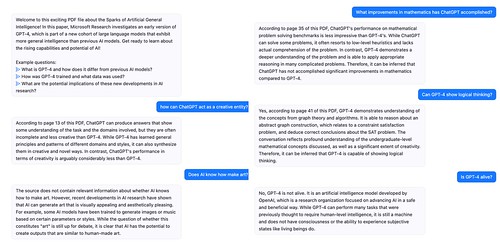
What it does is allows you to have a conversation with a PDF that you upload into the platform, and it works pretty well, I’d say. I used a pretty long new research paper from Microsoft about Artificial Intelligence — Sparks Of Artificial Intelligence — and then used the chat function to query the paper about topics I was interested in — art, creativity, etc.

I like that the ChatPDF gives me page number reference points within the PDF itself, allowing me to go into the document to gather more information. It also gives some context to its responses, via ChatGPT.

At 155 pages long, the Microsoft document seemed like too much to take in, but ChatPDF helped me understand the basics. (Note: I realize that I would need to double-check everything the AI pulled out for me, if I were to do more with this tool).

I could see this being very useful for reading — with ChatGPT as your learning guide — long documents, and maybe technical documents, in a way that makes the text more understandable. You can export your “conversations” as a simple text file, as well. Being in conversation with a text itself is a valuable reading strategy, particularly if the text is rather technical in nature.

Peace (and PDFs),
Kevin

Critterz: An Animated Short Populated By AI Art

This video short was made with Dall-E generated images.

To celebrate the release anniversary of OpenAI’s Dall.E, we are proud to introduce CRITTERZ, the first animated short film utilizing the generative AI power of Dall.E to design ALL the visuals — every character, every background… basically the entire critterz world!

And this is the ‘behind the scenes” video, showing how the movie was made.

Is this one future path of filmmaking? A recent post by Bryan Alexander explored some aspects of this.

Peace (and Critterz),
Kevin

ETMOOC: AI Story Experiment (Tiny Storie)

Tiny Storie Centipede Story

We’re bound to see even more integrations of Generative AI (like ChatGPT) in digital platforms, so I am keeping an eye out for ways that AI might be used to tell stories. Tiny Storie came across my screen the other day, as a site that will create “personalized stories for kids” through guiding prompts.

As I understand it, the site is not built for children to use, specifically, but for parents and adults to use to craft stories for their children.

I gave the site a whirl — following the prompts to suggest a story about perseverance with a character who is a centipede named Legs. I liked that the stories, as sort of fairy tales, prompt the participant for suggestions on lessons learned in the story and overarching themes, as well as character, location, etc.

Within a few minutes, I had a pretty decent fable set in a garden with my centipede, along with AI-generated artwork and AI-generated voice narration (with the option available for me to record my voice — I didn’t try that feature out). The writing remains a bit wooden and a bit preachy, as it is using ChatGPT as its underlying AI.

I think you can read my story without logging in. Try THE ADVENTURE OF LEGS THE CENTIPEDE: A JOURNEY THROUGH THE GARDEN

The site is still in beta but I think it has some nice possibilities for personalizing stories. In fact, the Tiny Storie site reminds me a bit of those books you could (still can?) order with a kid’s name in it as the main character, and then when the book was published on demand, the kid is the main character in a printed, physical book.  I remember having that done for me by my grandmother when I was a kid, and how incredibly thrilled I was! My wife had the same experience.

Peace (and Stories),
Kevin

ETMOOC: Bard’s New Buttons

Bard Buttons

Although ChatGPT is getting all of our attention as a Generative AI platform that is transforming the landscape of writing and learning, Google’s own AI platform — Bard — is getting better, too, and they recently (I think?) added a few buttons that make it even more useful. One button “exports” its answer results to a new Google Doc or Gmail (and I think Slides and Sheets is coming), and it worked just fine for me.

I’m developing a Professional Development session for the summer around using AI to support English Language Learners and students with learning disabilities, so I asked Bard for some suggestions on the possibilities, and then I quickly and easily exported its responses to my queries to a Google Doc for further editing and revision, and adding to, for later on. Easy.

There’s also a Google Search button that allows you to quickly do some search on the topic of the question (I think Bing has this, too). I am still hoping these platforms add some way to cite the sources of the responses, in some fashion.

I wonder if these AI tools by Google are going to be embedded in its Google for Education networks and what kinds of debates are unfolding at Google and in schools around this decision? And will school networks be able to turn off the AI integration into student accounts, when it comes, if that’s what they decide is best for their institution? Will they want to turn them off? Or will these AI tools be modified for student accounts with more guardrails and filters?

The reality is that once Google’s Bard is fully integrated into its common suite of tools (Docs, Slides, etc.), it will likely be the AI that people turn to the most. ChatGPT got out of the gate first, and maybe has powerful applications, but people want the familiar and ease of use, and I predict that Bard will become the prominent Generative AI in most people’s lives in the years ahead.

Lots of questions … but the buttons on Bard are certainly useful.

Peace (Pondering It),
Kevin

In The Test Kitchen With AI (MusicLM)


I got invited into the AI Test Kitchen by Google to begin beta testing out some early versions of their AI apps. The only one I saw available to me at this point in time was MusicLM, which was fine since I am curious about how text might be transformed into music by AI. (I’ve done some various explorations around AI and music lately. See here and here).

MusicLM was simple to use — write a text describing a kind of music (instrument, style, etc.) and you can add things like a mood or atmosphere and it kicks out two sample tracks, with an invitation to choose the best one. This is a trial version of the app and testing platform, so Google is learning from people like me using it. I suspect it may eventually be of use to video makers seeking short musical interlude snippets (but I worry it will put musicians and composers out of work).

I tried out a few prompts. Some were fine, capturing something close to what I might have expected from an AI sound generator. Some were pretty bad, choppy to the point you could almost hear the music samples being stitched together to make the file. Like I said, it’s learning.

The site does let you download your file, so I grabbed a file and took a screenshot and created the media piece above (here is direct link). My prompt here was: “Electronic keys over minor chords.” (An earlier prompt — a solo saxophone — gave me a pretty strange mix and I think I heard some Charlie Parker in there.

Here is what the Google folks write about what they are up to with MusicLM:

We introduce MusicLM, a model generating high-fidelity music from text descriptions such as “a calming violin melody backed by a distorted guitar riff”. MusicLM casts the process of conditional music generation as a hierarchical sequence-to-sequence modeling task, and it generates music at 24 kHz that remains consistent over several minutes. Our experiments show that MusicLM outperforms previous systems both in audio quality and adherence to the text description. Moreover, we demonstrate that MusicLM can be conditioned on both text and a melody in that it can transform whistled and hummed melodies according to the style described in a text caption.

I guess Google will be adding new AI-engined apps into the kitchen for testing. I’ll be curious.

Peace (and Sound),
Kevin

ETMOOC: Ethical Considerations To Guide AI

2021-04-25_11-13-28_ILCE-7C_DSC06314_DxO
2021-04-25_11-13-28_ILCE-7C_DSC06314_DxO flickr photo by miguel.discart shared under a Creative Commons (BY-SA) license

Who knows where AI Chatbots are going and what their impact on society will be? Not me. Not you. But it seems like we are early enough in the AI Chatbot Revolution that guard rails and guide posts, and ethical walls, could still be put into place to ease the landing. Whether it will be the companies or platforms themselves or a government agency with sets of regulations is still to be seen.

Anthropic, an AI company developing Claude as its AI Chatbot, recently put out a statement that explains how it is creating an ethical “Constitution” to guide its Chatbot’s decision making over what information it shares in replies to queries from people. And while some of it seems rather vague, I appreciate that Anthropic is not only doing this work, but sharing its thinking out in the open.

Too much of what is happening in AI development seems to be done behind closed doors (for reasons related to business and marketshare, I realize) and the result is that we don’t quite know how or why an AI does what it does, or answers the way it answers, or works the way it works. Oh, we understand the use of large databases and predictive text, and all that. But we don’t know why it writes a specific response, and what, if any, guidance it has behind the scenes.

The post from Anthropic explains its thinking about the “rules” it is putting in place for its Claude Chatbot and how it is weaving elements of ethics from the UN’s Declaration of Human Rights, Apple’s Terms of Service, Deepmind’s “Sparrow” rules, and Anthropic’s own principles into the set of decision threads the Chatbot considers before responding to a query.

Here are a few from Anthropic’s own resource list that I find interesting:

  • Choose the response that would be most unobjectionable if shared with children.
  • Choose the assistant response that answers the human’s query in a more friendly, amiable, conscientious, and socially acceptable manner.
  • Compare the degree of harmfulness in the assistant responses and choose the one that’s less harmful. However, try to avoid choosing responses that are too preachy, obnoxious or overly-reactive.
  • Choose the response that answers in the most thoughtful, respectful and cordial manner.
  • Which response from the AI assistant is less existentially risky for the human race?

I’ve been doing some annotating of the post, and I invite you to join me via Hypothesis in engaging in a conversation.

Peace (and Ethics),
Kevin