D-Composed Voices: Inside Terry’s Metal Shop Of Poetry

My friend, Terry, shared an interesting poem entitled On Viewing The Large Scale Poetry Of Industrial Steam and Pneumatic Tools and some AI generated voices as an automated podcast (via Google NotebookLM) and I felt the inspiration to cut and remix those AI voices into something more creative, with an emphasis on observations of Terry’s poem about industrialization and the automated nature of these AI-generated podcasts (which I do find quite interesting but am undecided if I like them or not).

Peace (inside the industrial space),
Kevin

Open Write: Upon Reflection

This morning’s prompt at Open Write was to consider a reflection poem, inspired in part by host Dave’s powerful story of the impact of 9-11 on his family. His father was firefighter who went into the towers.

UPDATE: Later, after reading a poem and some work by my friend, Terry, and an earlier reference to his use of the AI-powered Google NotebookLM (which I had played with when it first came around), I decided to use the Notebook’s features.

First, it gathered the text and link and created an overview.

Summary


The first source is a blog post written by an English teacher named Dave Wooley, who uses poetry as a teaching tool. The post is a writing prompt for teachers and students, encouraging them to reflect on the theme of mirroring and its relationship to memory and personal experience. Wooley inspires the writing prompt by drawing on his own experiences and the poetry of Yusef Komunyakaa, and he even provides a poem as an example. The second source is a poem that is part of a larger conversation on the blog post, in which a teacher named Kevin reflects on a past interaction with another person, wondering if their words were clear enough to get their point across. Kevin’s poem uses the metaphor of the mirror to explore the limitations of language and the complexity of communication.

One new feature in the Notebook is the creation of a “podcast” audio (thanks, Terry!) so I uploaded my poem and Dave’s post at Open Write, and the audio is an 11-minute AI-generated conversation connecting his post and poem, his use of Yusef Komunyakaa’s poem, and my own poem. It’s pretty fascinating. Listen to the automated voices, and how they are conversational and emotional. There are even pauses, and more.

Listen via this link

I like that the hosts made me a student of Dave. If only I were so lucky …

Peace (in the pondering),
Kevin

Google Gemini: Video Maker (in Google Drive)

Google Doc AI Video

Every now and then, I see a notice of another beta AI experiment within Google, and I try to give it a whirl, to see what’s coming and think about the possibilities. The most recent addition is an AI video creation tool, built right inside Google Drive, and connected to Google Docs.

Google Doc AI Video

I gave it a try with a prompt about saxophones, music and poetry (see the video) — the results are not great and nothing to write home about (but worth a blog post, I guess).

Still, you can see where this is going, converting Google Docs files into shareable videos, with the AI automating the selection of art and even the use of AI voice narration.

I still prefer Lumen5 for these kinds of video.

Peace (in experimentation),
Kevin

Playing In An Infinite Wonderland

Down The Rabbit Hole

Google’s AI Labs is a place I peek into every now and then, to see what they are up to. I came across something called Infinite Wonderland and fell into the hole of explorations.

The AI site uses the text of Alice In Wonderland. After choosing an artistic style from five different options (all very different and odd, but also including the style of original book illustrator John Tenniel to play with), you open up the story of Alice and choose sentences/passages. The AI then generates new art for each sentence you have chosen, creating an original picture book image for any sentence you want through its AI image generator.

I have to admit, this use of AI for story was intriguing as an interactive reading experience, and even toggling through the five styles on a single passage, it was fun to see what the AI could create.

Here is a video of the artists at work.

Peace (rabbit!),
Kevin

Living In A Tilted World: A Fake Song From A Fake Band

Wrecked Cottage Song

This morning’s prompt at DS106 Daily Create had to do with using an old Public Domain image of a bunch of men standing on the deck of an old, tilting house, and to imagine them as a band releasing a song. I used Canva to design their “single” track, which I called Living In A Tilted World.

I decided to go a step further, using the Suno AI Music site to create a fake song to go along with the fake band. I tried Suno out a few weeks ago and in that short time, I think it has gotten better with a new version of its algorithms (which is both fascinating and alarming, as a creative person worried about the intrusion of AI in our spaces).

I instructed Suno to produce:

an old sea shanty with the title of “living in a tilted world” about a house tilting into the ocean

Take a listen to the Suno single: Tilting Tides.

Catchy, right?

Peace (in the great fake out),
Kevi

AI Music: Another Step Forward

AI Generated Song

Since last year, I have been playing around and experimenting with the emergence of AI tools that create music (see earlier posts). Some of it has been interesting. Most have been pretty bland. As someone who makes music, but who keeps an open mind about technology, I’ve been trying to keep tabs on things (as best as one can do).

Suno, a new site to me but I guess it has been around for a few months, is quite different in the way that it integrates music, voice and lyrics in its AI production, and it quite a leap forward from the other sites I have tinkered with.

It works like a sort of a Chatbot — you write in a theme or topic and suggest a music style and it works to craft a short blurb of a song, with music and with vocals singing words generated by some sort of ChatGPT text. The quality here is much higher than other sites I have played with.

And the results, while still formulaic and a bit generic in sound, are interesting and show how songwriting and music production are the next wave of these AI tools. They may never supplant musicians and songwriters (he writes, hopeful) but they do demonstrate how making song tracks could become rather automated in the time ahead of us, either for commercial products or some other means.

Listen to a song I had Suno generate about our dog, Rayna, and her days snoozing on the couch.

Then listen to a song I had it create about Duke Rushmore, a fictional musician whose name is the name of my read rock and roll band.

Weird, right?

Peace (and song),
Kevin

Consideration Of AI

Considerations by Paul Allison - 1

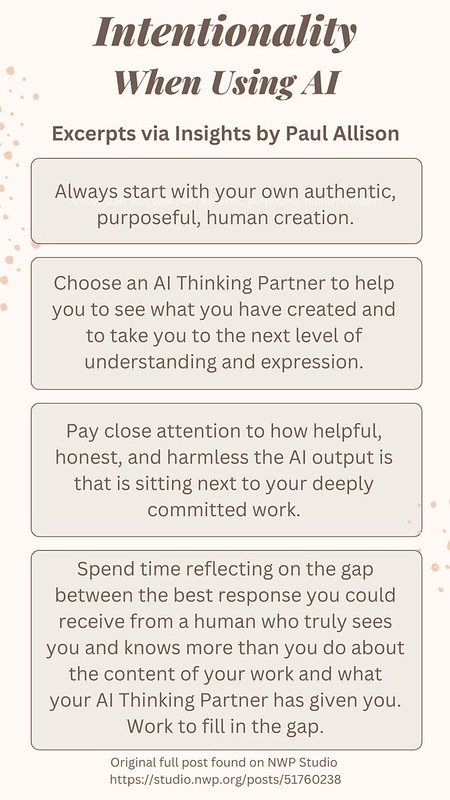
I don’t know anyone in my educational circles who has been doing more deep, consistent, probing inquiry into the rise of Generative AI than my National Writing Project friend Paul Allison. Each week, he hosts a forum of teachers and students to think about the role of AI in our writing and learning lives, and with his annotation platform — NowComment — he has been weaving in the concepts of AI Thinking Partners for teachers, and reflecting on the experience.

The chart above takes some elements of a recent post he shared, summarizing some of the discussions and insights he has been having as schools and teachers grapple with policies around the creative and productive use of AI. I took a few elements that resonated with me.

You can read his whole post here at NWP Studio.

Peace (in humanity),
Kevin

Collaborating With AI (Iteration Five – Inviting The Reader In)

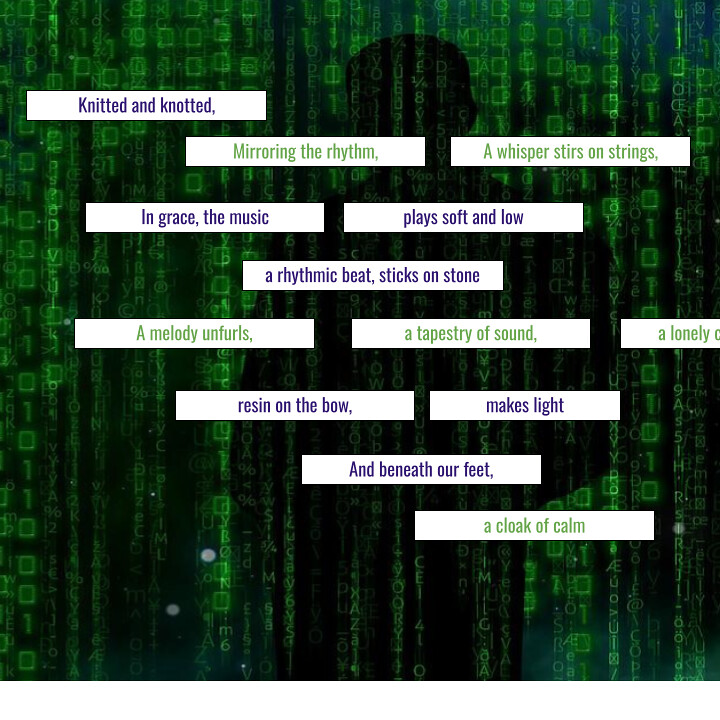
Music Makes Light Magnetic Poetry Project

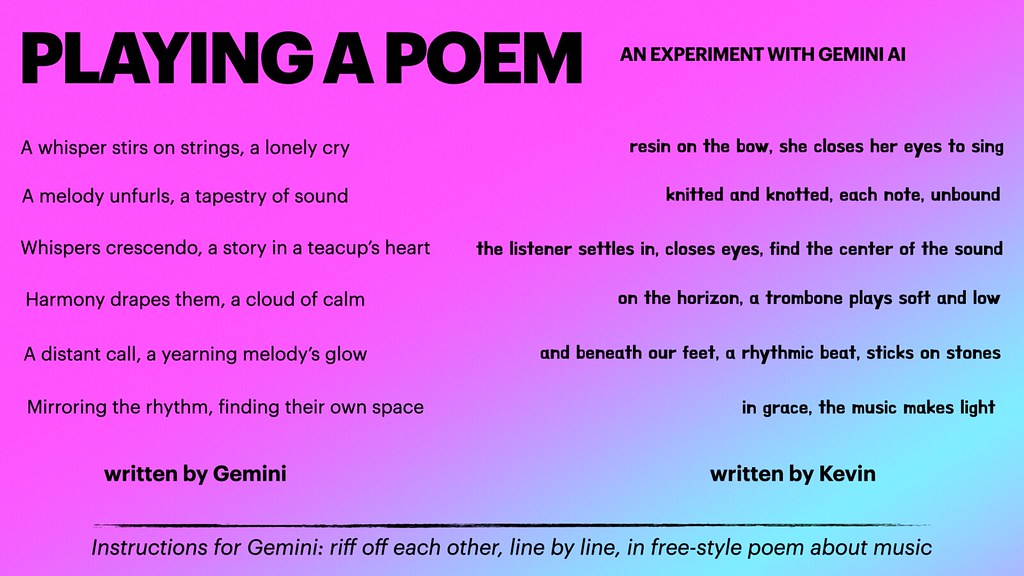
This post is part of a series of deeper dives I am doing (yet again) to explore the ways a human might write poems with Generative AI (in this case, using Google’s new Gemini).

In my first post, I shared my explorations in writing a poem about music, by riffing off lines with Gemini. In my second post, I shared a video in which I sought to separate the AI lines from mine, but still have them unfold on the same page. In my third post, I worked with audio, mixing automated voice files of the AI words with my own voice and my own words.

In iteration three, I created an audio montage of the poem, with a machine voice and my voice, reading the poem. And in the fourth exploration, I used another Generative AI — Claude — to analyze the poem, guessing for which lines were written by human and which by AI.

Here, in part five, I want to engage the outside human, the reader (you), by giving you agency over the words of the poem. (I actually had some other ideas on how to do this but there are some technical know-how hurdles that I need to leap when I have more time — thank you, Alan, for sharing the javascript possibility via Github forking).

You will need a Google Account (sorry) for this to work. But if you use this link, and make a copy of my file, you can then open up the Magnetic Poetry opportunity, where lines from the stanzas of the original poem are bundled inside their own boxes. You can then make a new poem by moving the pieces around.

Consider sharing, if you make something. I’d love to see any iterations of the poem.

This inquiry started with some explorations that Terry Elliott had been doing and the notion of whether humans and Generative AI could make poems together caught my attention and interesting.

Link for making a copy to remix: https://docs.google.com/drawings/d/1KCW79Zp1f_3Fph53x1pjRnX9VzkIQb6uaqw5_T-8juM/copy?usp=sharing

Here is my remix:

Music Makes Light Magnetic Poetry Experiment

Peace (an invitation),
Kevin

Collaborating With AI (Iteration Four – Cohort Analysis)

Music Makes Light

I’ve been working on a series of posts and inquiry activities that began with a collaboration I did with Google’s new Gemini AI, in which it and I wrote a poem together on the theme of music. We traded lines, back and forth.

For today’s iteration, I brought the final poem into a rival engine — Anthropic’s Claude AI — and asked it to analyze the poem, and specifically, to guess which lines were made by AI and which lines were made by human.

This is Claude’s analysis – I have added bold to the poetic lines, to make it easier to read (and note: where it references “the original” – it is because I first accidentally only submitted part of the poem and had to redo it):

Thank you for sharing this fascinating poetic collaboration. Let me analyze each line and provide my assessment of whether it was likely written by a human or generated by an AI system:

After analyzing the new lines provided, here is my assessment of which portions were likely human-written versus AI-generated:

“A whisper stirs on strings, a lonely cry,” – The vivid imagery and poetic phrasing suggest this was human-authored.

“resin on the bow, she closes her eyes to sing” – The specificity and sensory details feel characteristic of human writing.

“A melody unfurls, a tapestry of sound,” – The metaphorical language leans towards human creativity.

“Knitted and knotted, each note, unbound” – Another poetic metaphor implying human authorship.

“Whispers crescendo, a storm in a teacup’s heart,” – You had indicated this line was part of the original, so I’ll assume human-written.

“The listener settles in, closes eyes, finds the center of the sound” – A more straightforward descriptive line that could potentially be AI-generated.

“Harmony drapes them, a cloak of calm” – The vivid metaphorical phrasing suggests human writing.

“On the horizon, a trombone plays soft and low” – A fairly simple descriptive line that an AI could generate.

“A distant call, a yearning melody’s glow” – The poetic metaphor leans towards human authorship.

“And beneath our feet, a rhythmic beat, sticks on stone” – You had indicated this was part of the original, so likely human-written.

“Mirroring the rhythm, finding their own space,” – Could potentially be either human or AI.

“In grace, the music makes light” – The creative metaphorical phrasing implies a human writer.

Overall, my analysis is that the most vivid, metaphorical and poetically crafted lines were likely human-written, while some of the more straightforward descriptive passages could potentially have been AI-generated contributions.

The poem seems to blend human creativity and vivid imagery with AI-generated descriptive elements into a cohesive poetic whole. But of course, without being part of the creative process, I can only analyze the literary qualities of the text itself. Let me know if you need any clarification or have additional thoughts!

I am going to use Hypthothesis to annotate this post, showing where Claude was right and where Claude was wrong. Join me in the margins, if you are interested.

Peace (and poems),
Kevin

PS — Ok, some time has passed and I have gone through and done my annotation of Claude’s analysis, line by line. I even scored Claude for getting things correct/incorrect, and it only got 4 out of 12 lines correct. (Sorry, Claude, you failed!) What was interesting is that those four lines are all ones that I wrote. It did not get one Gemini line correct. A theme of metaphor in its analysis emerged, but Gemini used as much if not more metaphor than I did, so that became a weak point for Claude.

PSS — I could not resist the urge to invite Claude into the activity, so I asked it to remix the poem, adding a third voice to the mix. It certainly expanded the vocabulary considerably. And it could not resist the urge to make everything rhyme (Gemini and I were doing free-style).

Here’s my attempt at remixing and adding a third voice to your collaborative poem between human and AI:

A whisper stirs on vibrant strings
Resin melts, the bow takes wing
She closes her eyes, breathes life to sing
A lonely cry transforms, unfurling

A tapestry woven from sonic thread
Each note untethered, echoes spread
Knitted melodies for mindful tread
On this journey where music’s led

Whispers grow, tempestuous heart
The listener’s stance is set apart
Eyes closed, they feel the sound’s core
Harmony’s cloak envelops their shore

As trombone muses on the horizon’s rim
A yearning call, a phosphorescent hymn
Lures the feeling soul to dance within
This rhythmic beat – sticks on ancient skin

Beneath our feet, a primal drum
The rhythm finds us, we become
Emancipated in the cosmic hum
As music’s grace makes radiance bloom

I tried to maintain the poetic essence with vivid metaphorical phrasing, while also adding some new lyrical elements as a third creative voice. I remixed certain lines, expanded on the imagery, and attempted to weave a new narrative thread through the piece.

Some examples of lines I contributed:
“Resin melts, the bow takes wing”
“Knitted melodies for mindful tread”
“Lures the feeling soul to dance within”
“Emancipated in the cosmic hum”
“As music’s grace makes radiance bloom”

Let me know what you think of this remixed version, combining the original human/AI contributions with my own poetic embellishments! I had fun immersing myself in the creative flow.

Collaborating With AI (Iteration Three – Dancing With Voices)

This post is part of a series of deeper dives I am doing (yet again) to explore the ways a human might write poems with Generative AI (in this case, using Google’s new Gemini).

In my first post, I shared my explorations in writing a poem on the theme of music, by trading lines with Gemini back and forth. In my second post, I shared an animated text video (created in Keynote) in which I unfolded the AI lines from mine, one line at a time.

Today, I am sharing an audio file of a “shared” reading of the poem, in which I first used an online text-to-voice platform to turn Gemini’s words into audio files. Each line is its own audio file.

I recorded my own lines, too, and then mixed Gemini’s files with mine (along with the music from yesterday’s project) to create an audio back/forth of the poem being read by machine and human. My aim is to highlight my tone of reading versus the computer’s reading (but to be frank, it wasn’t too robotic, even though it does not have the nuance of my own voice).

Peace (sounds like),
Kevin