In The Age Of AI Search, Will We Still Be Curious?

Poster be curious, second version
Poster be curious, second version flickr photo by Ampersand Press Lab shared under a Creative Commons (BY-NC) license

When people seek information, we might think we have a question and we are looking for the answer, but more often than not, we benefit more from engaging in sense-making: refining our question, looking at possible answers, understanding the sources those answers come from and what perspectives they represent, etc.  — Bender/Shah, from All-Knowing Machines Are A Fantasy

Emily Bender shared this article, originally posted back in December, as the news hit that both Microsoft and Google are integrating advanced language model AI Chat functions within their search engines. Google announced their tool (Bard) yesterday and Microsoft has been ramping up its use of ChatGPT inside Bing.

An insight of theirs that struck me is how, just like when we wander a library or just like when we turn the pages of a newspaper, it’s often the randomness of the stumble upon something unknown that is the best experience. We might find a book we never knew we needed to read or find an article that has us looking for more information.

Search, for all its drawbacks in design and function, can be the same, in that when you try to find one thing, a search engine is often apt to also spit out something else. Now, this can be frustrating if you are looking for something specific. But if you are a curious searcher, a post with an odd header might have you wondering, and following, and discovering something new and interesting, or just weird.

In my reading of their article, Bender and Shah suggest that the age of AI Chat inside the search algorithms might hinder our curiosity, one of the things that make us human in the pursuit of information, as Chatbots serve us up more than we need, in a single screen space. They also address an linguistic component to the language the bots are using to provide us with information.

One of their main points is that we need to follow information back to its source, to determine its authenticity and relevance, in order to make sense of information, and AI (right now) does not necessarily allow us to do that. It just serves up information from its database in nice textual chunks.

But I’m reminded of a tagline from a YouTube channel by Hank Greene: Stay Curious.

Peace (and Wonder),
Kevin

NetNarr: Voice In Writing/The Arc Of An Idea

NetNarr: Voice

A new iteration of Networked Narratives, with Mia Z., is underway and she posted an in-class prompt — What is voice in writing? — as she and her students grapple with the age of AI, and what impact it will have on our writing. The prompt seeks to suss out the human elements of writing versus the algorithmic text. (see Mia’s university students’ responses)

I added my thoughts, with a poetic slant.

Voice in writing is the human element, the creative entanglement of a person with something to say, writing on the page, the sequence and the choice of words, the phrasing that indicates the writer behind the page, the arc of an idea.

But then, as so many of are apt to do today, I fed the question into ChatGPT to see how it might respond:

Voice in writing refers to the unique perspective and tone an author adopts in their writing. It gives the writing a sense of individuality and can convey the author’s attitude, personality, and emotions towards the subject. Voice can affect the style, tone, and mood of the writing, and can make a piece of writing more engaging, memorable, and relatable to the reader. — ChatGPT

Sounds like an academic voice.

Peace (in the Arc of an Idea),
Kevin

Rusty, The Rock And Roll Robot: From AI Art to AI Story with AI Music

Maybe I went a little overboard here but I was curious about what would happen if I merged the output of a variety of different AI-infused sites to create an AI story from an AI image with a computer-generated narrator voice backed with an AI soundtrack. The result was a tale about Rusty the Guitar-playing, Rock-and-Roll Robot.

Here’s how it worked: This all began with an interactive article in the Washington Post about how AI engines create art from text prompts. The article is excellent and the tool to play with was worth tinkering with, so I used the prompt to guide my experiment along: A robot playing guitar in outer space in style of a cover of a magazine.

AI Art via WashPo

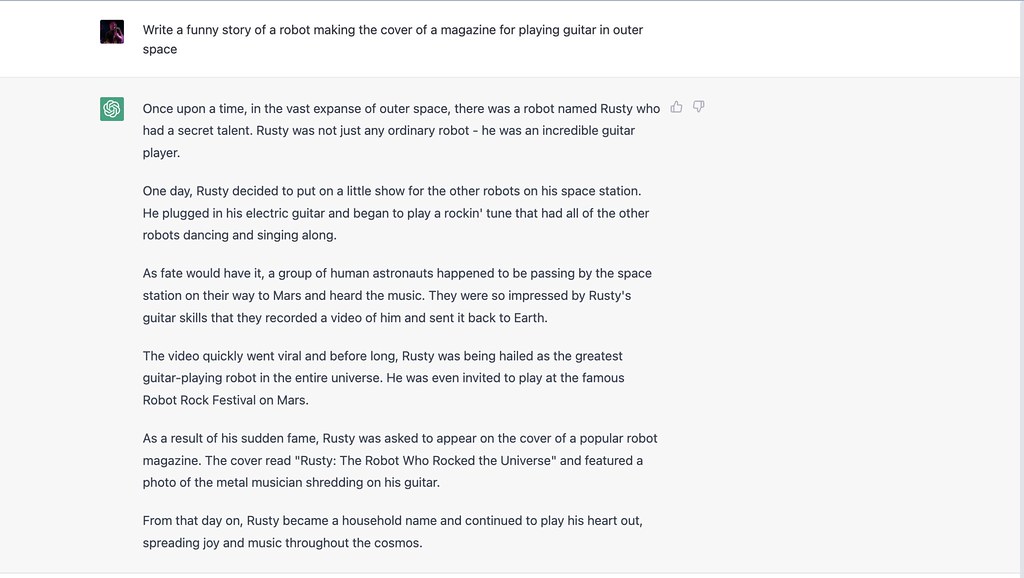
I had an interesting image that I downloaded but now wanted a story. So I opened up ChatGPT and typed in this prompt: Write a funny story of a robot making the cover of a magazine for playing guitar in outer space.

Within seconds, I had the text of a story about a robot named Rusty who was rocking the space jam and ending up going viral and landing on the cover of a magazine. I took a screenshot the story.

Story via ChatGPT

I went into LunaPic to merged the Art image with the story, and added a border. Neat.

AI Art Meets ChatBotGPT

Now I wanted some voice narration. I used a text-speech site that wasn’t AI, really, but the computer-generated voice worked for what I needed: a “narrator” reading the text of the story of Rusty as an audio file.

Knowing this would become a video project, I wanted some soundtrack music. I went into a site called Melobytes, which takes an image and used AI to convert it to music. I used the combined Rusty Art/Story from LunaPic, and got a soundtrack. (I remain a little skeptical and unsure of how Melobytes really works its AI magic, but I stayed with it because I could not find an alternative for this activity).

I also used Audacity to mix the music with the narration, and then went into SoundSlides to pull everything together into one project, with an image backed by audio.

Is it any good?

Well, it’s interesting as an experiment, I think, and it shows how more and more AI projects could become collaborations across platforms.

Is it writing?

I don’t think so, but it was an act of “composition” as I tried to weave different threads of the story, generated by machine, into a coherent media project.

And you know, it’s likely that some company will surely bring all of these AI tools — art, text, music — under one umbrella at some point, and I am not even sure if that is a good development or bad idea when it comes to the world of stories.

Peace (press Play),
Kevin