
Flickr has gathered up and curated a collection of photos to connect to the 250th celebration of the founding of the United States. There are a lot of archival images there.
Peace (and the past),
Kevin
If you don’t live it, it won’t come out of your horn. ~ Charlie Parker
Flickr has gathered up and curated a collection of photos to connect to the 250th celebration of the founding of the United States. There are a lot of archival images there.
Peace (and the past),
Kevin

The prompt this morning (connected to MyFest) was to choose a color of caring, and use TinEye to filter photos. I added a gif dog, too, because Alan asked us to wave hello.
Peace (and greetings),
Kevin
The prompt was to make a song but I went in another direction and made a video poem.
And then later, grabbed the audio and made a song of loops and effects.
Peace (fingers clacking away),
Kevin

Peace (with solitude),
Kevin
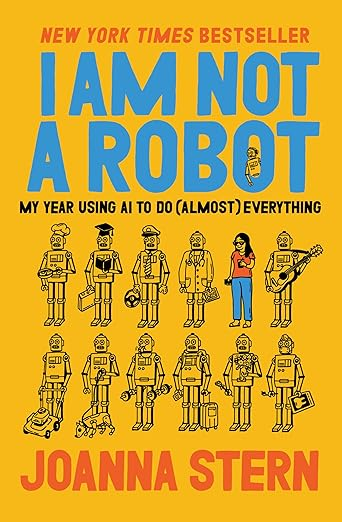
A.J. Jacobs has carved out an interesting writing career by immersing himself into different scenarios and then writing about it in entertaining and enlightening ways. It’s not a new genre but one I find interesting. Joanna Stern and her new book — I Am Not a Robot: My Year Using AI to Do (Almost) Everything — is in the same vein, and that is not a knock on Stern, a talented technology writer who literally spent the year actively searching out AI to use.
Stern’s approach makes sense in the world we are living in, where AI seems to be everywhere and inevitable. She maps out how she invites AI into her family life — from apps to robots — and casts a critical eye on issues of privacy and transformation of work and play from the infusion of technology. She also writes with humor and compassion, and allows her position as a mother to be forefront in her final analysis of the potential of this technology. She brings robots into her household, uses AI as her therapist and romantic companion (with permission from her husband), and uses the technology to organize her notes and thoughts, allowing it to access her files and record her voice. She goes all out with AI.
And she emerges both impressed and skeptical, and at times, worries. Aren’t we all?
Stern wisely notes that while she, as an adult in these times, has agency to choose whether AI is in her life, her own children and others growing up today might not have those same options. Given the many questions – around privacy, and security, and the unknown — she wonders how young people will navigate the world through inquiry and curiosity, if the answers are just a query away.
Same.
Peace (and wonder),
Kevin
When I can remember, I try to curate six months of Silent Sunday photographs into one single video. Here are my photos from the first half of 2026.
Peace (in the lens),
Kevin

Peace (on the lake),
Kevin

Today’s prompt for DS106 Daily Create was to write a poem for John Johnston, so I visited his microblog and used some of his posts for inspiration for four short poems.
Shadows, spun
and spinning, a glimpse
of wonder, coming undone
in an afternoon pause
https://johnjohnston.info/blog/tdc5278-three-happy-moments/
A butterfly moment,
with tired wings at rest,
standing like a painting
on a leaf of green
https://johnjohnston.info/blog/silent-sunday-80/
Curating a life in links –
a visit here and a word there –
places to stop and wander into
while the world shuffles by
https://johnjohnston.info/blog/tag/lifeinlinks/
An observation, from afield:
we are all but subjects in a social experiment –
some of us, swirling eddies
in the ripples where we can write
https://johnjohnston.info/blog/liked-we-ran-a-huge-social-experiment-on-a-whole-generation-it-turned-out-to-be-terrible/
Peace (and poems),
Kevin

The DS106 Daily Create asks us to capture three moments of happiness in recent days. I started with the GIF above, which comes from a slow motion video my son took of our dog. Then I added an image from a visit this week to the southern coast of Maine.

Then last night, as I listened to a free jazz fusion show outside a local brewery, I noticed the bartender had lined up its coasters with the brewery catch-phrase: Peace Love Beer.

Peace (and sharing),
Kevin

(Collection of invented words submitted this year to the Crazy Collaborative Dictionary project)
I admit: Out of curiosity, I fell into the trap of asking Claude to analyze a project that I have overseen for more than 20 years, with my sixth graders inventing new words.
This Crazy Collaborative Dictionary project — which I have written about before — had been part of an inquiry into the Origins of the English Language until this past school year, when we moved to a new district curriculum and my independence was a bit curtailed. But I did find time to get my kids to submit words this year, anyway. And now that I am retired from teaching, this year is the last year of this project.
You can view an archive of the dictionary project here: https://dogtraxwrites.com/crazy-collaborative-dictionary-project-archive/
I asked Claude to do a deep dive and analyze any threads that seemed interesting. Here is it’s response, with a note that the byebyebyebye word is actually mine, not one by a student.
What a treasure trove. I’ve read deeply through the archive now, and there’s a lot to unpack across ~1,400 words spanning 2005–2026. Here’s what jumps out:
Students are operating in a handful of recurring creative modes, often without knowing it. These aren’t random — they’re predictable cognitive moves that tell you a lot about how children this age process and play with language.
There’s a striking cluster of words formed by simply reversing a real word. Students have independently rediscovered this trick across multiple years:
What’s lovely is that Drawkcabology is a student naming the very thing they’re all doing — and then there’s Esrever (2025) and Dniwer (2025) appearing decades later, suggesting this is a strategy students figure out independently every generation, not just from seeing prior examples.
Roughly 15–20% of all entries are invented diseases, conditions, and phobias. Kids are particularly drawn to this form — perhaps because a disease feels authoritative, like something you’d really find in a dictionary. The conditions tend to fall into sub-categories:
Silly physical conditions:
Behavioral compulsions:
Portmanteau fears (phobias):
The phobia entries in particular show kids learning Latin/Greek suffix patterns and having tremendous fun with them. Dannydevitoyeetusphobia (the fear of Danny DeVito throwing you off a cliff) is essentially perfect.
Combining two animals is one of the most popular invention strategies, appearing in every year:
There’s even a multi-combo: Flabberdootle (2012) — a platypus, walrus, dragon, and alligator. The biological creativity here is unbounded. Students instinctively understand that portmanteau names signal hybrid concepts.
Food mashups are a perennial favorite, reflecting what sixth graders think about constantly:
The coffee variations in 2009 are particularly funny as a cluster — likely the same class exploring a theme together.
The dictionary functions like a cultural time capsule of what technology meant to kids in each era:
The word Antiphonism appears in both 2006 (“against phones”) and 2019 (“against listening to sound”) — independently coined, same concept, showing how phone anxiety spans generations but shifts meaning.
Students love constructing fake academic disciplines. The longer and more absurd, the better:
The longer the chain of Greek/Latin roots, the more authoritative it sounds, and students have clearly absorbed this from school. Some of these are nearly indistinguishable from real scientific terms.
This is consistent across every single year of the archive. The body-function portmanteau never dies:
The 2017 cohort in particular seems to have had a very enthusiastic body-function era. And Bombomclap in 2026 suggests the tradition is alive and well 21 years later.
A disproportionate number of words describe the specific act of falling, tripping, or failing to maintain balance — possibly reflecting a universal sixth-grade preoccupation with awkwardness and embarrassment:
The specificity is wonderful. Tripoozle in particular has a whole epistemological theory built in — when you trip over nothing, the rational response is to run a gravity check.
Some of the invented words have real counterparts in other languages or dialects, which students would have no way of knowing:
The most delightful single entry may be:
Byebyebyebye (2026) — Words spoken out loud by an ELA teacher who is retiring from Norris Elementary School.
That’s the students writing the teacher into the dictionary. The whole 21-year project folded into one word, timestamped at the end.
The emotional range is narrow but deep. Most words cluster around: confusion, falling, hybrid creatures, food, and body functions. Very few words address sadness, longing, love, or fear in earnest — though Unselfdeplira (2014) (“unable to be yourself around others because you’re scared you won’t be perfect”) is a quietly profound exception.
The very long words are a consistent power move. From Aheolaphoalamprosolpooslopeleroadeasoloper (2005) to Aacklewakleshmaklebaitmatefaitnatelateinforintilkjghipikoplintinbinlintfingibblesssshintin (2026), kids have always understood that a word’s length can itself be a joke. The latter means simply “hi.”
Drow gets reinvented independently in 2005, 2014, and 2023 — three different students, three different years, the same word (“being asked a question you can’t answer” vs. “saying a word backwards”). The archive is full of these quiet collisions.
What a project. Two decades of sixth-graders trying to make language, and in doing so, making a pretty good record of what it felt like to be eleven.
I enjoyed this analysis, more than I should have, perhaps. Claude went in directions I hadn’t even thought of.
Peace (make the word true),
Kevin