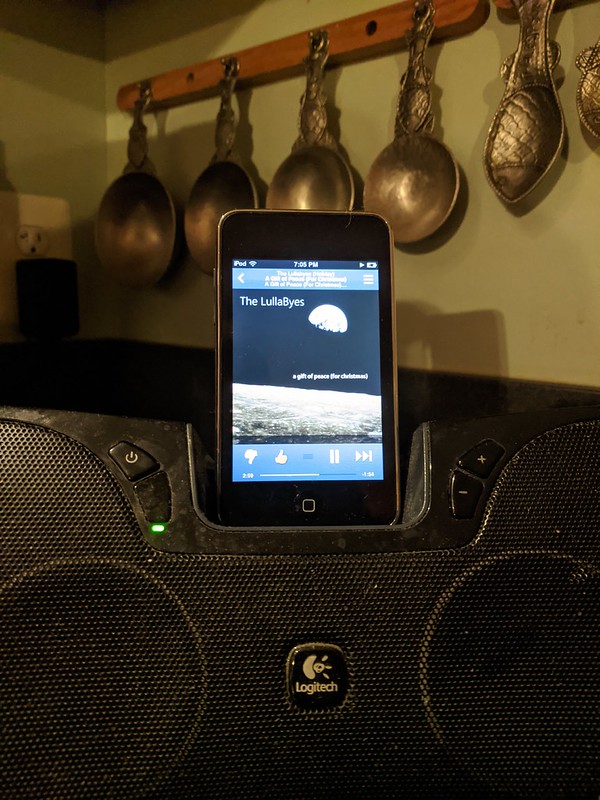
A few years ago, my good friend, John, and I went into a local recording studio to put down tracks for a song we had written (years before that) as a holiday gift of song. Each year, I try to share it out and hope our Gift of Peace brightens your day. The video was shot and produced by my eldest son.
While it was written as a Christmas song, I hope its message of passing the peace to one another might resonate whatever your beliefs might be, religious or not.
The song is on all streaming sites, and I got a kick the other day of hearing it again on Pandora. If you search A Gift of Peace (for Christmas) by the Lullabyes, you should be able to find it.
Wilco’s Jeff Tweedy is always an interesting read, or listen. In his new book – How To Write One Song — Tweedy turns teacher and cheerleader, urging people to find ways to be creative. Or, as the title suggests, to try to write a song.
Tweedy is certainly a talented songwriter, as far as I am concerned, and I liked the folksy voice he inhabits here, in this book, as he tries to explain the magic of being creative — of losing yourself in the moment of making art out of ideas and inspiration — and then moves into his own routines and practices around writing songs.
I’ve read enough books about writing in general (and the teaching of writing, which is what I do with sixth graders) to know there is nothing revolutionary here in terms of his advice and suggestions, but I appreciated the way he pulls it together, and his explanations of how to stitch ideas to music (even if you only know an elementary level of any instrument) to recording demos (he advocates finding a simple record/play app) was helpful.
For me, a songwriter myself, the best parts of the book were when Tweedy tries to find a way to explain what happens when he loses himself in the making of a song, and how three hours or so can go by, and he comes up for air, invigorated and inspired by a few verses set to simple strumming of his guitar.
Tweedy reminds us that creating art is something unexplainable at times. But when it comes together, it can be something beautiful, in both its outward expression (how it looks, how it sounds, etc.) and the inwards satisfaction of the one who has created it.
I kept nodding my head at these parts, appreciative of his way of grappling with artistic expression in ways that just cannot be fully explained in words or writing. In that, is the magic, and why I (and maybe you) keep coming back to the guitar or piano or whatever to make music.
Nothing energizes me or enlightens me or gives me comfort like when I am writing a new song that has some kernel of truth and possible beauty to it (even if that beauty is only in the eyes and ears of the beholder).
Tweedy also put out a new album – Love is King — that he references in the book and Rolling Stone Magazine has a good interview with Tweedy.
Nate Sloan and Charlie Harding are music nerd friends who host an interesting podcast — Switched on Pop — that became the anchor for this book of the same name. In it, Sloan and Harding dive into pop music to figure out what makes songs and styles tick. In doing so, they brilliantly bring us deeper into tracks and showcase things you might intuit as a listener but not have the vocabulary or expertise to completely understand.
This book — Switched On Pop: How Popular Music Works and Why It Matters— is fantastic in this regard, and Sloan and Harding make a perfect set of tour guides, being both ecstatic about the songwriting and production moves they uncover as well as pointing out the tropes that have long been hallmarks of pop music culture, whatever the decade.
Starting with an analysis of Carly Rae Jepson’s Call Me Maybe, to Outkast’s use of unusual rhythms in Hey Ya; to the use of voice and timbre by Sia in Chandelier to Justin Timberlake’s use of “text painting” in What Goes Around; to samples as collage by MIA in Paper Planes to a comparison of two song with the same titles — Made in America — the Toby Keith version side by side with the Jay Z/Kanye West/Frank Ocean version … the paths of this book are varied and deep.
They reference Swedish producer Max Martin numerous times — he is the one who has crafted songs over the last decade or more for Brittney Spears, Kelly Clarkson, Taylor Swift and many more — and while the writers note how often Martin seems to fall into tropes, he also is adept at adapting to the changes of production and sound and song types, transforming the way pop music is made and heard. A brilliant essay here shows how Maps by The Yeah Yeah Yeahs was used by Martin to create Since You’ve Been Gone by Kelly Clarkson.
The book ends with a look at one of Paul McCartney’s strangest releases in recent years called Get Enough, which weaves Auto-tune and modern sounds with some old fashioned instruments and McCartney’s ability to craft another “silly love song” for the modern age.
If you are a songwriting (as I am) or love music (as I do), this book is well worth your time. I highly recommend it, if only to give you another way to “hear” the songs that make up the musical landscape of radio (remember that?) and YouTube and culture.
This video, and all of the 12Tone videos, is great for thinking of how we might imagine the writing of lyrics for songwriting. I have all sorts of techniques, but I am also always looking for other ways to get inspired.
And then there was this one, too
Thanks to Verena for sharing this out as part of another piece of sharing she had done.
I’ve been trying to write each month with the folks at Open Write via Ethical ELA (it’s pretty inspiring how many people come to write there), and it works by having just five days of writing prompts each month (so, manageable). The email notifications are always welcome, as I always forget it is coming up.
Mostly, I work on my daily poems with the prompts. The other day, the theme of ‘thanks’ came up for the first prompt of November, and I began a poem about the greeting cards you get from stationery stores, and then veered into something different, something more interesting (for me).
The shelves have become
barren of those silly cards,
those throw-away phrases
that always tried so hard
to make us laugh, in aisles
of the grocery store and
boutique shops and kiosks
in the mall, manufactured thanks
spit out by cold machines,
while I’m still one of those few
who settles down in the quiet,
pen in hand, to carve out poems
from the bones of memory,
a crinkled paper-cut of words
tucked into the folds
of your jacket pocket
It was the place where the poem took a turn in the middle with the writer becoming self-aware that I could not shake throughout the day. I found the words becoming lyrics in my mind all day long, small phrases dancing in my mind, and finally, I had time to sit down with my guitar, and I slowly began wrangling the poem into another shape altogether, turning the lines into lyrics of a song.
An interesting and challenging element of this process is that the rhythm and rhyme of the poem didn’t quite work (I’m not sure why I even heard the poem as song verses, given the lines) and so I found myself moving the pieces around, adding words, twisting phrases — all in the service of song.
I was intent on keeping the meaning, though, of a poet — feeling a bit estranged from the world, of thinking they are “one of the few” still scribbling words to paper – still writing, and intent on tucking words into the pockets of another person, hopeful that the poems will be found and recognized, and read. I think I was successful in this thematic connection from song to poem.
Paper Cuts You (Everywhere You Go)
I may be one of the few
to settle down
in the quiet and write you a poem
I wish I knew
how to share the silent
the way memory holds us like bone
the paper cuts you everywhere you go
These four walls
these blue lines
the days turning into night
I can’t recall
what it is we said
I’m tucking words inside your sleepy head
dreaming on this paper bed
And if it rhymes, it’s time
to break it all apart
I’m the poem inside
the pocket of your heart
And if I had the words
then we’d be OK
I’d hold you in the dark before the light
So close the door
pull on the shades
I’m writing you from somewhere yesterday
and tomorrow will be better than today
And if we find it’s time
that we make it from the start
I’m the poem
inside the pocket of your heart
The music was first recorded as a rough demo with only guitar and voice as a way to get it down. I found I liked what it was in that rough format but the song needed a bit more lyrically to bring things around to something hopeful. So I began all over again — adding other instruments — keyboard, piano, bass, guitar, strings. I wanted to keep my voice front and center — the poet, thinking — and the guitar fairly sparse strumming, more like a mandolin (the capo is high up the neck).
In the end, the song is different from the poem — the middle section, with worries that the poet is falling into method as opposed to heart, turns things a bit and the last parts give more hope, with the poet being the poem inside the pocket of the heart — but the pieces are still connected by some invisible string, circling around the central idea of a writing having hope that words can still impact the audience – even an audience of one person.
My friend, John, has long had a vision of producing a country album on his bucket list. John and I play in a rock and roll band but his country project was something he always wanted to do, drawing on Hank Williams and others as inspiration for the sound he was after. So many months ago, he started to write the music and then he asked if I would contribute lyrics, and I readily agreed.
We had worked on some of his songs live, with our bandmates, and then the Pandemic hit and that came to a sudden pause. So John did it all solo at home in what he calls The Demonstration Tapes, and the tracks are, as he explains, published drafts for a possible future studio project.
I tried to write the lyrics as character sketches for a general theme that John had in mind, and it was an interesting experience to try to do a whole collection of songs this way. John and I have collaborated before, many times, so this was not a new experience, but I really wanted to give him words that would make his songs work as he wanted.
Listening to what he did, from a distance, I am proud of the stories in running through his songs and happy that music remains a connection point in our friendship.
I shared a new song entitled With You With Me the other day and wanted to use the draft lyric sheet (this is often what my notebook paper look like as I am writing songs — messy, with crossed-out words and phrases, and crammed things all over the place) to annotate what I was thinking as I was writing the song.
I did this annotation in Thinglink (which allows for audio embeds and layered notes) for myself but maybe you will find it interesting, too.
Here’s another one from a summer of writing songs. I think I may share some layered thinking about the writing and recording of the song in a few days.
I am not sure if this new song — Sitting On Horizon — is part of my Notes from a Quiet Corner project of music written and produced during and about the Pandemic …. Maybe it’s a late add to that mix … the lyrics are inspired by thinking about the days ahead and the unknowns of that waiting …
Sitting on Horizon
Everybody’s waiting
‘cause nobody knows
today’s hesitation
is where tomorrow always goes
We walk around in daydream
sink me like a stone
We’re fingers on the touchscreen
but in the slipstream, there’s no flow
You can take me
when you need me – I’ll go
I’m writing you this letter
from somewhere in the past
I hope you can forgive me
with the shadows fading fast
I’m stuck inside the story
with the place gone mad
It’s not as if you lost me
it’s the world we used to have
you can find me
when you want me -I’ll go
You can call me
when you need me -I’ll go
maybe when we’re older
when time turns slow
we’ll sit on the horizon
and remember what we don’t know
‘Cause everybody’s waiting
but nobody knows
today’s hesitation
is where tomorrow always goes
You can take me
when you need me – I’ll go
you can find me
when you want me -I’ll go
You can call me
when you need me -I’ll go
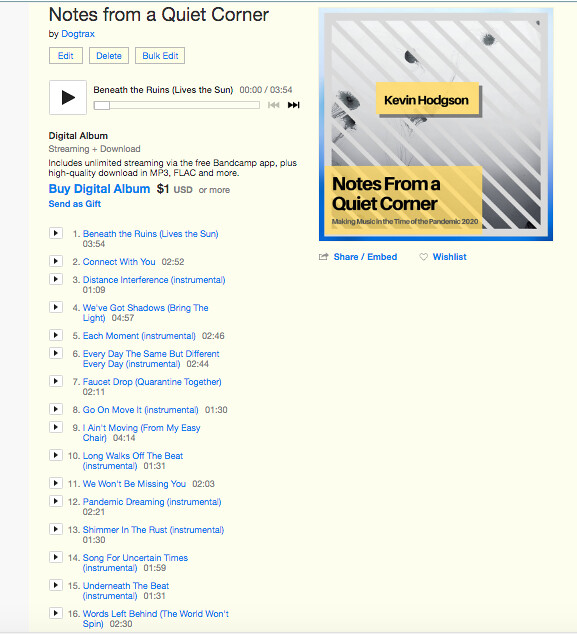
I’ve been sharing individual songs here and there, written since the start of the Pandemic back in March, and now I have gathered the 16 tracks (some instrumental, some songs) together into a collection on Bandcamp entitled Notes from a Quiet Corner. Making music is one of the ways I process the world.