View from the Seats: Watching Ready Player One

via Warner Brothers

Ready Player One could have been worse. A lot worse. It also could have been better. A lot better. Split the difference? It was an entertaining movie with, as my older son noted afterwards, “more holes in the plot than you could poke a stick through.” My younger son, who has read the book by Ernest Cline at least six times in the past two years, added, “The book was better.” I was more charitable with the movie than my three boys were, it turns out (which is usually the opposite).

We watched Ready Player One in 3D in the XD theater and that was a good move, as the immersive storytelling element of the movie — part of which takes place in a virtual environment known as The Oasis — was made livelier by the 3D experience. And Steven Spielberg sure knows how to pack a visual punch, and to allude to all sorts of 1980s pop culture elements.

If you don’t know the story, Ready Player One is about the world in the future where the collapse of energy and food resources has people living in the Stacks — literally, mobile homes and cars and such all stacked upward — with the only real ‘escape’ from the apocalypse is virtual reality in The Oasis gaming world, where endless smaller worlds can be created around themes. The story revolves around our teenage hero — Wade Watts — as he tries to find the hidden Easter Egg left behind by the creator of The Oasis. Finding the Egg will mean gaining ownership and direction of The Oasis.

The game design element of the novel is what lured me into the story years ago, and my youngest son loved the book when I passed it along to him. The movie captures some of that tension between real life, outside of technology, and the digital life we create and make for ourselves inside the spaces we inhabit. The use of avatars and digital identity, of ethics of shared virtual space, of commercialization of online experiences, and of the imagination in building worlds all emerge as themes of the story.

Elements of the game itself get buried in the movie by all of the 1980s pop references, though, and the potential to use the intricacies of game experience to drive the plot (sort of like Wreck-It Ralph did pull off) falls by the wayside in favor of a more typical good/bad battle.

I did appreciate that one of the underlying messages, made a bit too obvious by the end, is that collaboration and cooperation for a greater good are more powerful than profit and personal gain. The corporate loses. The collective wins.

Also, the new rule created by Wade and his friends in the end that The Oasis gets shut down every Tuesday and Thursday, in order for users to break from the technology and reconnect with friends and family (cue end scene of Wade smooching with Artemis, the real heroine of the story), seemed rather relevant to our modern times. Imagine if Facebook or Twitter decided that two days a week, no one could use the site?

Me, neither.

Peace (with popcorn),
Kevin
NetNarr: Getting My Alchemy On

Each day, I continue to use the prompts from the Daily Arganee of Networked Narratives to write a short poem or piece as a creative exercise. I am more apt veer off-topic than to stay on-topic with the prompts, but I aim to go where the muse takes me. Periodically, I’ll go in and gather and curate them into a short video.  The one above is my recent collection. These down below are some of the past collections of the short pieces — which I compose in an app that only allows six seconds of framing.

When NetNarr is over, I’ll have to figure out what to do with all the pieces ….

Peace (telling it),
Kevin

#NetNarr: Hacking/Remixing the Game of Chess

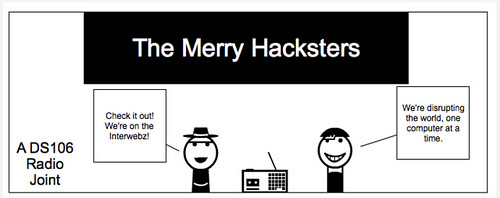
Merry Hacksters Title DS06

A few years ago, for DS106, I was part of a group that did a collaborative radio project that centered on the art of remixing. My segment centered around an activity I do with my sixth grade students, remixing and hacking the game of chess to create something new altogether. It is part of our Game Design Unit.

Here is the radio segment I did:

Peace (hacked for greater good),
Kevin

PS — here is the entire Merry Hacksters Radio Show

Six Word Slice of Life: From Design Flow to Interactive Story

(For this month’s Slice of Life Challenge with Two Writing Teachers, I am aiming to do Six Word Slices most days, with some extended slices on other days.)

Context: I wrote the other day about the ways my sixth graders were making design plans to create Interactive Fiction stories inside Google Slides. Since then, they have been working hard to bring the stories to fruition, and by yesterday, many were finishing up the writing and proofreading of their stories. I enjoy this time of reading the finished game/stories, after so much work with conferencing on narrative ideas and technical assistance.

Six Word Slice of Life Student Stories

You can read a few of their stories (It’s best to go full screen to experience the pieces … use the hyperlinks to move along the narrative choices):


Peace (make a choice),
Kevin

#NetNarr: GameLoop GameSounds GameOver

This week, in Networked Narratives, the theme is on games and one of the challenges is to use audio to tell a story, and the audio should be game-themed. I decided to try to make a short song loop, with game sounds. No story except, there’s always a “game over” moment in a game.

By the way, if you want to join me in annotating the video hangout session that the NetNarr folks and guests did on the topic of gaming and learning, come into the Vialogues with me. I’m slow-watching it and adding comments off to the side.

Visit the Vialogues

Peace (play it),
Kevin

#NetNarr Post-Hangout: Sending Gifs

via GIPHY

I could not attend the online Google hangout the other day for Networked Narratives, which featured guests Amy Burvall and Michael Branson Smith on the art of the animated gif, and the possibility for expression with the social media photo formatting. My friend, Wendy, suggested on Twitter that we make gifs from the hangout video, and well, that sounded like a fine idea.

I did all of this within Giphy itself, which has stickers (which I keep forgetting about) and a drawing tool (ditto).

Here is the original video:

And then I went a little nutty. First, I found a neat shot of the Alan, Amy and Michael, and added … a few special guests to the hangout.

via GIPHY

Then, I grabbed video of a gif art project and made it further into art with some gif doodling.

via GIPHY

Peace (animated within reason),
Kevin

#NetNarr: Patent Entertainment With Animated GIFS

Original Patent: https://catalog.archives.gov/id/16972882

The folks over at Today’s Document surprise me now and then when they slip an animated gif into their RSS feed, usually in the form of an item about one of the patents in the Library of Congress. (They also will regularly convert video archive moments into animated gifs, but I find these illustration remixes to be the best to enjoy).

Original Patent: https://catalog.archives.gov/id/6277655

I’m always fascinated by the old drawings in the patent applications, so the animated gif is another fun way to bring history alive. The animations are more whimsical than informative, to be frank. More entertainment, than educational.

Original patent: https://catalog.archives.gov/id/6858602

It’s still nice to know there is always a chance to inject some fun in the dusty archives of history.

And the Library of Congress itself even created a GIF to show the construction of its building. This is more educational than entertaining, showing the construction of a national treasure (which holds national treasures).

And finally, there are those out there in the wild world that take vintage photos and … well … spook them up a bit.

Created by Kevin Weir via http://fluxmachine.tumblr.com/

Peace (learning it),
Kevin


#NetNarr: Getting a Bit Crazy, Making GIFS

Over at Networked Narratives, the theme is now shifted into GIFs, and all the wacky things you can do with them. Alan’s assignment calls for a GIF storm of sorts in the #NetNarr hashtag, including GIFs that connect with the Digital Life underpinning and finding narrative points in the clip from the Western movie The Big Country to pull out as animated moments.

So …

First, I went in to the clip and found the dramatic scene where the rider and horse are trotting away (later, the men will join the solo rider in a dramatic turn-around.) I use the Gif It add on for Chrome Browser, in case you are curious. The function gets built right into YouTube video viewer. Easy peasy.

via GIPHY

Then, I went into Frinkiac, a GIF generator of Simpson’s clips and found a Karaoke scene, so I layered in dialogue from the same clip I Gif-ed earlier, but made it into a sing-along song.

via GIPHY

Finally, I was watching the latest Courtney Barnett song, which is all about trolling people on the Internet, and grabbed a clip to Gif.

The video is cool and strange and weird, so the Gif is, too.

via GIPHY

Finally, this morning, a student in the NetNarr Universe had shared some time-lapse movie making, and I grabbed a gif out of Roj’s work, just to see what might happen when a time-lapse becomes a gif. It’s interesting.

via GIPHY

Peace (slow mo),
Kevin

#NetNarr Discovery: Lost In Hyperland (A Fantasy Documentary)


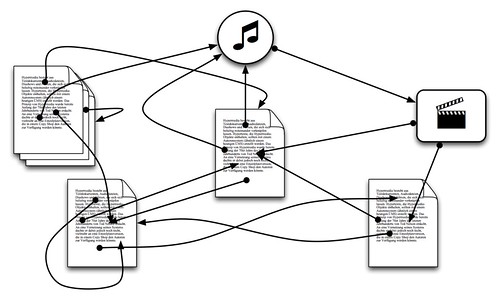
Hypermedia flickr photo by Dominik W. Neuffer shared under a Creative Commons (BY-NC-SA) license

Thanks to some sharing of an article by Wendy in Networked Narratives a few weeks ago, I stumbled on this 1990 film about where hypertext might be going, with novelist Douglas Adams.

The Internet Archive site explains a bit more about Hyperland:

In this one-hour documentary produced by the BBC in 1990, Douglas falls asleep in front of a television and dreams about future time when he may be allowed to play a more active role in the information he chooses to digest. A software agent, Tom (played by Tom Baker), guides Douglas around a multimedia information landscape, examining (then) cuttting-edge research by the SF Multimedia Lab and NASA Ames research center, and encountering hypermedia visionaries such as Vannevar Bush and Ted Nelson. Looking back now, it’s interesting to see how much he got right and how much he didn’t: these days, no one’s heard of the SF Multimedia Lab, and his super-high-tech portrayal of VR in 2005 could be outdone by a modern PC with a 3D card. However, these are just minor niggles when you consider how much more popular the technologies in question have become than anyone could have predicted – for while Douglas was creating Hyperland, a student at CERN in Switzerland was working on a little hypertext project he called the World Wide Web…

Peace (link it beyond),
Kevin

In Celebration of Reading and Writing: Mobile Storytelling

In a time when so many of us bemoan a seemingly apparent decline in writing and reading in young people, this video reminds us that maybe we are looking and observing in all the wrong places. Check it out. Candice Faktor shows us where and how young people are engaged in stories and fiction.

This is part of a cool video series I found that dovetails nicely with my thinking of how to use technology to transform writing and literacies. I’ll sharing out other videos in the coming days, too.

Candice Faktor – Mobile Storytelling: The Rebirth of Reading and Writing

Peace (read it, write it, live it),
Kevin