I was driving to school yesterday and I caught this piece on NPR about social media effect — but on how kindness can also spread. We focus so much on the dark side of the social networking effect on us in terms of negativity that it is good to remember that we also respond to the positives of our networks — that one person doing a kind thing for another has a ripple effect.
This week’s Studio Visit in Networked Narratives was with Anne-Marie Scott, and I put the video archive into Vialogues for those who want to join me in another round of slow-listening and commenting in the margins. Anne-Marie will be watching the discussion, so feel free to leave her questions there.
This is a helpful video with John Greene about reading deeper, and understanding, digital information and digital media. Greene, author (The Fault in Our Stars) and vlogger (often with his brother), digs into how we can understand what’s behind the veil of what we read online, and to understand the move he calls “lateral reading.”
Greene’s key question of inquiry that we must always ask ourselves: Who made this and why?
He explains that we have been taught to read “vertically” — starting a text at the top, reading across line by line, ending up at the bottom. Like a book. Unless it’s manga (sorry, had to get that in). Reading “laterally,” he explains, means opening new browser tabs, checking information out against the original, jumping from the main text to complimentary text.
He suggests we become more active readers, checking information out before diving in with belief. Understanding who is funding sites, and why, is key to understanding how design and algorithms influence our thinking and understanding.
I’ve been taking my time, listening over a few days to the classroom conversation that the always-intriguing Chris Gilliard had with Networked Narratives the other day.
Chris is insightful in his look at how technology impacts our lives, bringing to the surface not just the privacy issues but also the concerns of how our data might be used against us (and is being used against us) by companies and governments. Chris is wary of the digital landscape but also is optimistic that users can force changes for the better (or I infer his hopefulness, which maybe just is my own reflection that the ship can still be set right).
The video is in Vialogues, allowing for conversation in the margins. Thanks again to Karen for joining, and hoping others will, too.
Networked Narratives hosted a Twitter chat the other while folks were watching this video — We’re Building a Dystopia Just to Make People Click on Ads by Zeynep Tufekci — and so I popped the video into Vialogues for slow viewing and commenting.
Thanks to Karen and Terry for jumping in with me, so I didn’t feel so alone in the digital landscape of manipulation engines and algorithmic targeting of my data.
You are invited, too, to watch and react. Tufekci is insightful, connecting algorithms of advertising to the creeping elements of an authoritarian state. It’s not that much of a leap, unfortunately.
This morning’s DS106 Daily Create call for “making stuff” was to merge a name with a famous person with the name of something else. Betty White Cake was the example (chuckle).
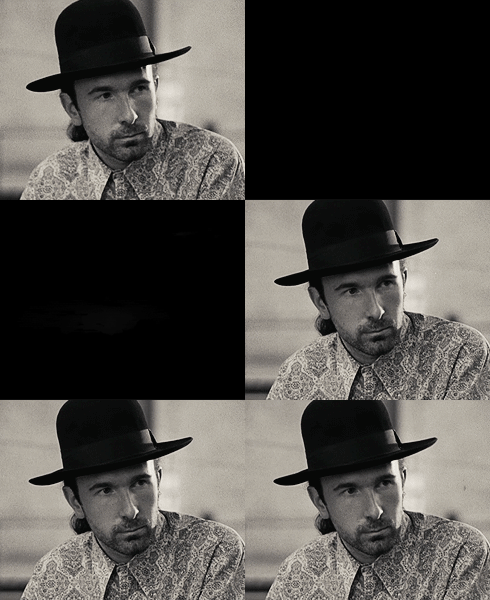
I wanted to do Edge of Darkness, with the U2 guitarist. And I wanted to merge two animated GIFs — the Edge with a dark scene — but I didn’t know how to do that. So I learned how.
I searched the Net and re-discovered Animated GIF Maker (which I have used before to make a single GIF) and learned that you can upload multiple GIFs at a time and then arrange and re-arrange the frames. It’s not perfect but it worked for what I wanted, a hint of the darkness of The Edge.
Now all I need is a soundtrack for the end of the world …
I took that piece by Wendy and added a few more layers, writing a second poem (video at the top of this post) and then using a few different media apps to create what was fast becoming what Wendy called an onion. Only hints of the first layers are visible.
I had to look that word up: palimpsest — “… text (that) has been scraped or washed off so that the page can be reused for another document …” from Wikipedia. Sort of both, then, I guess, and layered. Neat. #netnarr#Modigiwri
Most documents prior to the widespread use of wood pulp to make paper were either on parchment (lambskin) or fibre such as hemp, cotton or linen. 1832 Library of Congress newspapers feel like old handkerchiefs. #easytoreuse#netnarr
My wife and I have been watching the television show, YOU, for the past few weeks, creeping out on the storyline. Besides shouting at the television for all the narrative holes in the plot (there are many) and for characters not seeing the obvious, it’s been sort of fascinating to watch how social media is baked into the fabric of the show of obsession.
This isn’t the first television show to necessarily do this — use social media and technology as a key storytelling device — (see Black Mirror for other examples) but YOU utilizes it so well for telling the story over an entire season — for the obsessive surveillance of one character over another (usually Joe watching Beck but sometimes Beck watching Joe); for a character who is a social media influencer, as her job; for creating fake accounts to create a false reality; for ghosting people and people worried about being ghosted; for tracking people down through bits of information; and more.
As You is situated in modern day New York City, it explores the dangers of social media culture with an emphasis on a lack of digital privacy.
Mobile phones for these young adults living in New York City are never far away from any character in the show, and when one character – Beck, a writer, of all things, who’s at the heart of Joe’s obsession — has her devices and apps and router all shut off by a colleague so she can actually write, the cold-turkey-syndrome of being so bored we see her pacing her apartment, doing all sorts of things (other than writing, alas) before finally giving in and booting up her router.
This might be you. Or me.
Television has long been a window on culture, if often slightly warped by narrative design. YOU is one of those shows, reflecting our desire to be connected to the stories of others and to project our own version of stories for others to read. YOU also shows us the surveillance state we have allowed ourselves to be part of, where tracking the histories and present of another is often as simple as following accounts, where we openly and freely share lots of information.
YOU uses this digital connection to creep us out with how the digital world feeds and nurtures obsessions. Maybe we should pay attention a bit more to what it is telling us about our world out here, beyond the screen, too.
This video by Nerdwriter (whom I support via Patreon) seems like it could connect with the inquiry now being done in Networked Narratives around technology, surveillance and agency.
Dark Patters are “crappy user experience that intentionally makes it difficult to do something ” that hurts the company. In other words, intentional design to thwart our own agency as a user. This is a fascinating look at this concept.
This is oddly intriguing and a bit unsettling. The video, shared in Networked Narratives, shows kids in 1966 chatting about what they envision as the future. So much of it was about Nuclear War, overpopulation, and the end of the world, and it’s sad to think how much was on the minds of these kids.
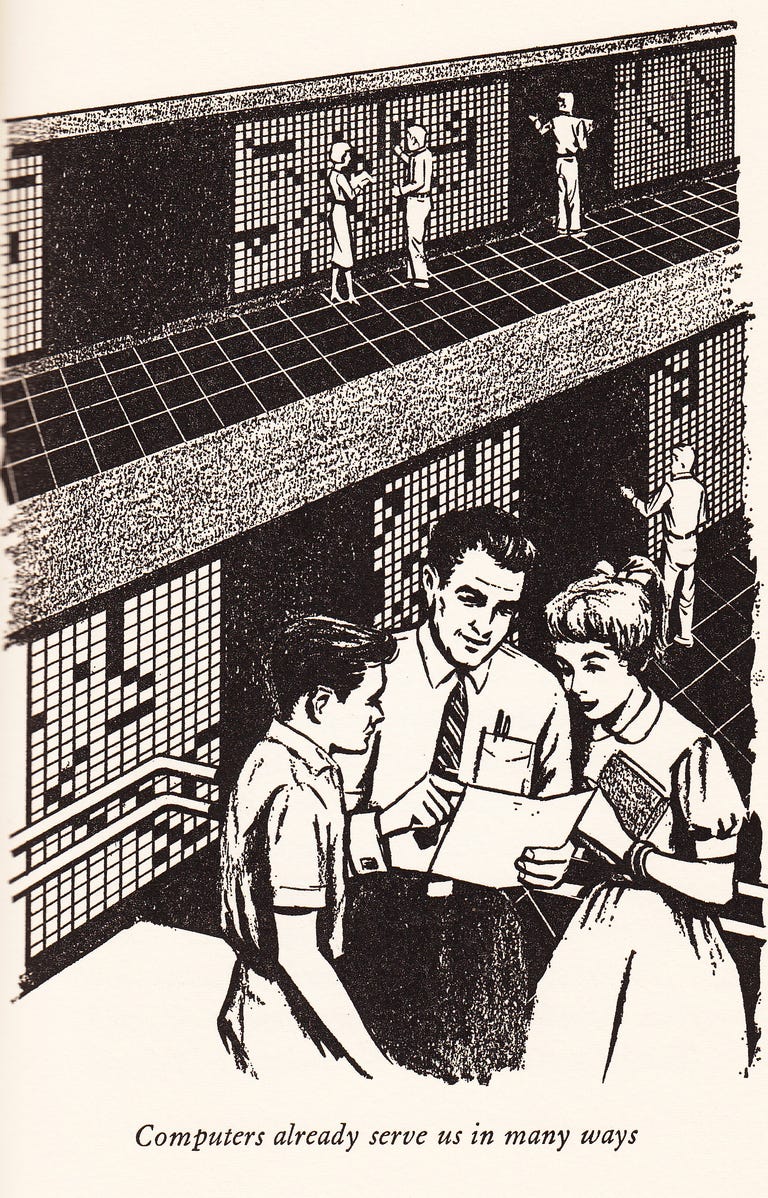
Another article had drawings of ideas of kids imagining the future, taken from 1961. An artist rendered their ideas as illustrations. Here, mainframe computers were already “serving” us (sort of like the aliens in Twilight Zone).
What about today? I teach young students, and when we have discussions these days about what’s ahead, mostly they seem optimistic, and expect that technology will be able to fix and solve most problems. They are often startled when we do a unit on technology and talk about data, privacy and more. The one significant concern many have? Climate Change. Although, they are less worried for themselves, and seem more worried about animals and ecosystems.
I was also reminded of this picture book — 2030: A Day in the Life of Tomorrow’s Kids — which is more optimistic and fun, following a kid through a day of talking dogs and virtual classrooms, and conveniently ignores most of the social and dehumanizing ramifications of technology.