School began yesterday with staff training, and two hours of protocols on staying safe with students and teachers in a building re-opening in a Pandemic was eye-opening and exhausting. Shout out to our school nursing staff, though, who are doing a phenomenal job with sharing information and guidance.
The school year starts today, but the year begins with state-sanctioned 14 days of professional development before students begin (our school is doing a phased-in hybrid model). But this is when the sleep of teachers gets regularly disrupted, and the Pandemic makes it worse, of course.
This comic oversimplifies the sense I am getting in listening to our School Committee meetings, observing local social media postings of residents and local elected officials, and reading the news — but it does seem as if the goodwill towards that educators that came in the Spring when the Pandemic hit, and we working non-stop to reach and engage our students via remote, has shifted to more finger-pointing and negative tone as plans to re-open developed, at least where I am.
Some of the comments in the second panel are actual versions of things I have heard said or read in the last few weeks, and while I know this represents only the vocal people who are worried about how to balance it all and that the quiet ones may be supportive, it’s still disheartening that educators are becoming targets of scorn when it is a lack of a national effort to deal with the virus that has put us all in this spot.
Also, it is important to acknowledge that the current landscape is complicated for everyone, whatever their views. It may be that I am defensive in what I hear because it feels like educators are targets in a political scene, fed by the president.
I’ve been meaning to spend some time looking into the use of HyperDocs — sort of an updated version of Webquests in which a single document with hyperlinks provides students with multiple entries of engagement and exploration. It’s a concept that I have seen from time to time, and thought, yeah, someday, I’ll take a look.
But it was a post at Middleweb by a National Writing Project friend, Jeremy Hyler, another middle grade teacher, and then an interview on NWP Radio with Jeremy on the topic that provided me with a reason to sit down with HyperDocs with intention and ponder how it might be a good fit for a school year of remote and hybrid learning.
I quickly discovered that I appreciate HyperDocs as an approach of using a single document with multiple strands of activities for students, although it obviously requires, as Jeremy notes, work at the start by the teacher to think through sequences of learning activities and also choice opportunities for students to demonstrate understanding, with room for extension for those students who need a bit more.
While I come to the concept via NWP and Jeremy, I want to note that Laura Highfill, Kelly Hilton and Sarah Landis are prominent voices in the mix. The three educators facilitate and oversee the HyperDoc website, along with assorted course offerings, and they say they coined the term and concept in 2013.
At their website, the HyperDoc founders note:
A true HyperDoc is much more than some links on a document.
Creators deliberately choose web tools to give students opportunities to Engage • Explore • Explain • Apply • Share • Reflect • Extend the learning.
Digital collaboration is choreographed to give every student a voice and a chance to be heard by their classmates.
Critical thinking and problem-solving skills can be developed through linked tasks.
Students have an opportunity to create authentic digital artifacts to show what they know and connect with a wider audience.
In some ways, HyperDocs consolidates much of what teachers were already doing with research and online media exploration, but maybe doing even more so during forced closures due to the Pandemic. It leverages the resources of the Web, but also integrates well with any online platform, such as Google Classroom. Where I used to have multiple posts with different steps, spread out over a week, let’s say, a HyperDoc contains the entire sequence of activities, with media and text set explorations, in one document, allowing a student to move through the expectations at their own pace. The term “flexibility” comes up a lot with HyperDocs.
While there is no set structure of a HyperDoc, most seem to start with some essential questions and inquiry, leading to application of understanding, and then extension opportunities, with lots of places for reflections on process. Take a look at some samples to get a better sense of the HyperDoc concept. It’s important to note, I think, that you could easily design a HyperDoc as a simple website/blog post, in any text format that has links to the Internet, in Google Slides or presentation software, etc. It does not require a Google Doc, since the most important parts are links to follow, opportunities for reflection and sequencing of information.
The HyperDoc site has samples and lots of information, and I even ordered The HyperDoc Handbookfrom the HyperDoc folks just to have another resource handy. But there are plenty of other places on the Internet where teachers are sharing templates and ideas. I’ve “borrowed” a few (including the one that Jeremy talks about in the NWP podcast) and have been busy adapting for my own needs.
At this point, I have four different HyperDocs under construction for the start of the year: an icebreaker Back to School Hyperdoc, a literature-themed Hyperdoc focused on a short story and exploration of literary concepts, and a civic action HyperDoc that explores student agency.
Here is a link to a fourth HyperDoc I am creating as part of a Professional Development I am co-facilitating at the start of the year with colleagues on Project-Based Learning. This HyperDoc that I created utilizes the idea of the tiny Public Service Announcement (inspired by AJ Juliani) to show teachers a way to simulate PBL, and it can be adapted for the classroom, too. It has been built off a design that Jeremy had shared (thank you).
What’s great is that with some initial instruction and guidance for students (I even found a HyperDoc that explains HyperDocs to students), I can use HyperDocs for independent learning in both a Hybrid model (when I will see only half my students at a time but they are expected to be doing things the other half of the time) and for a Remote model (where none of us are going to want to be on the video screen for long stretches of time).
The flexibility and leveraging of online resources, plus the integration of other technological platforms like Padlet, Flipgrid, VoiceThread and others for reflection and sharing points, seems like it could be a winning way to use technology effectively for teaching and learning.
I’ve been trying to periodically do an audio podcast journal entry as a teacher in a Pandemic and this latest comes just a few weeks before we start our new school year.
It’s hard not to think that Trump’s announcement last night that he will ban TikTok in the United States is either another attention diversion from the terrible economic news and his handling of the virus OR if it’s the result of a personal grievance after TikTok users claimed responsibility for the Tulsa Trump Campaign ticket disaster that led to nearly nobody showing up.
He cites the company’s ties to China and privacy and data issues, which is something to be legitimately concerned about and something I have tried to follow over the past year. Unfortunately, you can’t trust a Liar In Chief like our president on anything. His motives are almost always personal and fueled by grievance.
It’s also true that Trump rarely follows through on anything he says (Where’s that health care replacement he keeps saying is coming, three years later?) He doesn’t have the stomach for any real governance, just for headline grabbing. (which, to give him credit, he is a genius at).
Maybe he’s trolling us on TikTok, too.
I’ve written about TikTok before because it was the start of school last year (so long ago now in memory, in a pre-Covid time) that so many of sixth graders were not only talking about TikTok as the app of the moment, but throughout the year, they would break into popular dance movements whenever we were lined up to go anywhere. The viral nature was another level of attention. (See this blog post and this one and this one)
I also shared how we had discussions in class about the possibilities of China having an influence on TikTok and whether the gathering of information from the app on users was being shared with the Chinese government (that part is not clear but there were enough signs about its data collection to be worried, and enough worries to talk about it with my students during our lessons about digital platforms and privacy).
And I also know, with the Pandemic closing of school in the Spring, TikTok became a refuge of connection and entertainment for so many of my students, who were making videos as much as watching videos on the TikTok feed. TikTok and YouTube were the most used platforms by young people, I would venture a guess.
So I wonder what young people will think now that the president has decided TikTok should be banned outright, and may use his presidential emergency powers to do so (I don’t quite understand how, and I suspect legal challenges will tie it up for a long time, and that this still accomplishes Trump’s goals of diversion in the news and minds of the country as people are dying on a daily basis from government incompetence). He claims a ban could happen as early as today.
I also think that so much of what the president and Congress does seems intangible and removed from the world of young people, but not something like this. If the president bans their favorite app, and shuts down their main connector to friends and entertainment just as the anxiety of school re-opening is taking hold, young people may be most affected, and perhaps, may become political as a result.
Or they might just shrug shoulders and move to the next ‘big thing’ app, whose name we (or at least, I) don’t yet know but probably is already gathering steam just beyond our adult sight-lines.
This is the latest in short audio reflective posts I have been making periodically since the Pandemic hit in March. This one follows a decision about re-opening by our School Committee.
I’ve long been exploring how we might expand notions of what writing is, and what composition is, for years, and so have many others, particularly those of us affiliated with the National Writing Project. More than ten years ago, a book I co-edited Teaching the New Writingcentered on this topic.
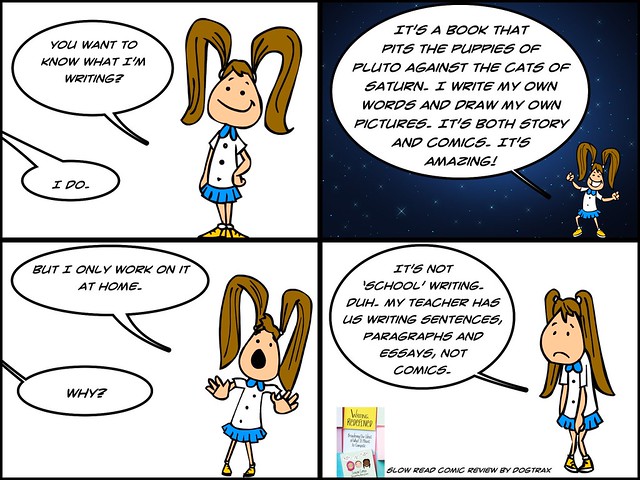
(Note of disclosure: Shawna sent me a copy of her book to review. I made and shared comics as I was reading her book).
In her book, as in her teaching practice, Shawna explores a lot of terrain, but in a thoughtful way that balances rigor and exploration, bringing her own experiences as a teacher and literacy coach into the mix, and the wealth of resource she shares via QR Code within the book is staggering, and sure to keep an interested teacher inspired. As I think about her book, I wonder even more than ever how we might use the moments of the Pandemic/stay home to bring more of these kinds of authentic writing ideas into our online spaces for students, to engage them in meaningful compositional strategies and projects.
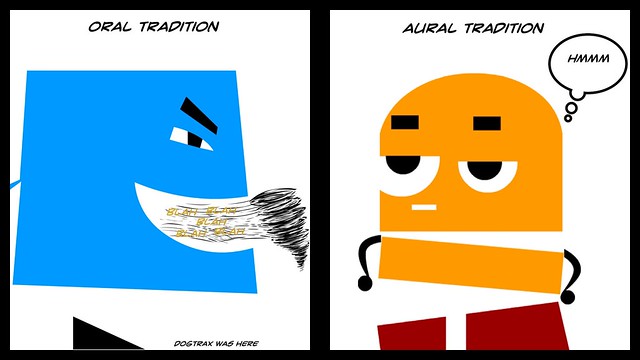
Shawna effectively makes the case that by limiting “writing” to words on a page, as opposed to being part of a multi-modal multi-medium stew of visual, audio and more, we are limiting our students as writers, too. We’re asked to think about alphabetic forms of writing (essays, etc.) might form barriers to students who struggle with traditional writing, who might have language barriers, who might have cultural barriers (particularly those students from cultures with a focus on oral traditions), who have other strengths to bring into the writing classroom.
Each chapter digs deeper into topics, but I appreciated the last chapter, where she anticipates the many questions and concerns teachers might have about ‘redefining’ writing with a larger net. Shawna patiently counters six different concerns with thoughtful, helpful advice and considerations.
While she may not have broken new ground in her book, Shawna effectively frames the discussion on what it means to write in this modern, digital, visual and audio age, in a way that can reach classroom teachers knowing that the dichotomy for young people of “school writing” versus “non-school writing” is always evident, but not insurmountable. Shawna builds some bridges.
I facilitated a workshop with colleagues the other day on using Google Classroom with students, but first, I brought us all into a collaborative document to write and reflect together on the previous three months of unanticipated Distance Learning. I was curious to know the pros and cons of our work now that we had a moment to take a breath together. The chart above gathers some main themes from what we wrote about, together. I suspect there might be some universal themes from teachers in other places.