CLMOOC friends gathered and created artwork for a collective calendar for the 2022 year nearly a year ago now. Download it for free, if interested. I composed a short piece of music for each month as my contribution, and I am sharing out each month’s track at the start of each month.
In my last composition for the calendar project, I spliced in a sax solo from a holiday song that my friend, John, and I wrote and recorded in the studio.
Give me a book about music, and I am a happy reader.
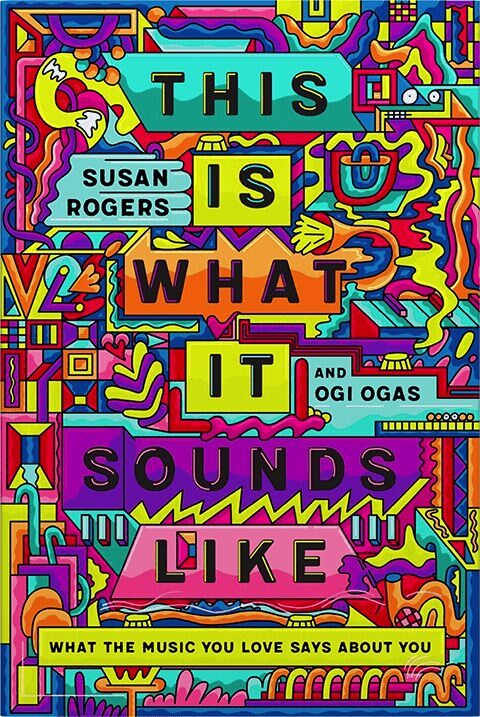
This new book by Susan Rogers and Ogi Ogas goes beyond that. This Is What It Sounds Like is a tour de force, a well-written invitation to think about our choices in the music we listen to and that we love in the moment and over time, and Rogers (who is the primary voice here) is the perfect tour guide.
Rogers’ background is impressive, beginning as someone who helped build recording studios, to a stretch of time as a producer/engineer with Prince, to a producer of many other artists, to her time now as a cognitive neuroscientist and professor at the Berklee College of Music in Boston. Ogas is a published author of books about the brain and the way we think.
The book weaves in and out of Rogers’ stories in the music recording field, but finds it anchors in some key areas as the book explores why we love the music we do, why everyone’s tastes in music will be different, and how we can expand our ideas of not just what art is but how art provides an opportunity to enrich our lives.
The chapter titles give an overview of the topics of music listening:
Authenticity
Realism
Novelty
Melody
Lyrics
Rhythm
Timbre
Form and Function
Falling In Love
In each section, the reader is given insights on the listening to music that is intriguing, with “Record Pulls” — the sharing of songs with others that gives an insight to someone else on your own personality. The songs we share with others say something about ourselves, and Rogers believes in the idea of “Record Pulls” to shine a light on not just our listening but aspect of our personalities. (You can even join the online Record Pull that they have set up at their website: https://www.thisiswhatitsoundslike.com/record-pull)
All in all, this book was beautifully written (a few sections veer deeper into brain science, in relation to music, but it was definitely approachable to the general reader) and the insights had me thinking in new ways on songs and artists and music that have defined who I am for years.
I highly recommend This Is What It Sounds Like. Plus, you can listen in to the Virtual Jukebox of songs referenced in the book.
My youngest son is a talented music producer and he just dropped his latest album today — Good Time. It is available on all of the main streaming services and showcases collaborations with other artists. My son, Rowan, did all of the music production. (note: there are explicit songs, so be warned.)
CLMOOC friends gathered and created artwork for a collective calendar for the 2022 year nearly a year ago now. Download it for free, if interested. I composed a short piece of music for each month as my contribution, and I am sharing out each month’s track at the start of each month.
CLMOOC friends gathered and created artwork for a collective calendar for the 2022 year. Download it for free, if interested. I composed a short piece of music for each month as my contribution, and I am sharing out each month’s track at the start of each month.
For a DS106 Daily Create the other day, which I had submitted, participants were encouraged to use an automated music making site called Computoser. It allows you to set some algorithmic parameters and then kicks out a short “song” for you. I find it rather interesting but also a bit constrained.
So, after making my own song for the prompt, I downloaded the MP3 file and moved it into another platform (Soundtrap) to do some of my own mixing. That led to me noticing that my friend, Sarah, had submitted her entry. Hmmm. I layered her track on top of my track. (Note: I suggest headphones, particularly for the later iterations, where there is a lot going on in the mix that is best experienced with close listening)
That was too dissonant for me, though. That’s when I saw that the site kicked out MIDI files, as well as a MP3s, and so I took her MIDI files and mine, too, and then began layering her song with mine. The use of MIDI presented me with many more options for mixing, since now I could change the instruments and align the timing, so that it began to sound more like a single (strange) composition as opposed to two pieces of music crashing into each other. I added a drum track, too, and it acts as a sort of rhythmic ballast. At this point, we had seven tracks.
Shortly afterwards, another friend, Maha, added her song, and so I went through the process yet another time — adding Maha’s MIDI tracks to the song that I was constructing with Sarah and mine. At this point, I was working with ten tracks. Maha’s tracks gave the piece a little more atmosphere and depth (Again: this is best heard with headphones, I think)
Finally, a day or two later, I saw another friend, Sheri, had also added one and the process continued once again, with the tracks from four of us (total: 13 tracks) — all of us, connected friends from various projects over the years — mixing them all into a single song. Sheri’s additions added a space-like swirl to the gaps in the piece as well as a rhythmic hand drum and a breathy sound, allowing the music to become more like a braided knot, with different strands working together.
And then I realized, one other connected friend, Christina, had also created a song. As before, I downloaded, uploaded and mixed. It becomes a bit much for the ears at times, with that many track, but then, there are moments of melodic separation, where something lovely happens. (Now total tracks: 17!)
Why do all this? First of all, I am always musically curious. But there was something larger at play here — which is a continued exploration to humanize AI experiments (or, as Sarah noted, to approach the activity of using AI with human intention and agency). I don’t mind that the music site automatically created songs from my algorithmic settings, but I felt like I still needed to insert myself as mixer and engineer, even on a small scale.
Adding in the work of connected friends seemed like an obvious move to me, bringing us together as a band of creative people. It made the final track much more interesting than if it had been just my own. Thanks to Sarah, Maha,Sheri and Christina — who found out they had contributed after the fact. I hope I honored their sharing into DS106 with this CLMOOC-ish kind of activity.
The final “song” is still quite odd, with instruments weaving in and out of each other, although the drum track I added keeps the music somewhat centered and moving forward on a beat. If you listen, there is a distinct melody line at the top of the track, and there are some harmonic elements moving below it, so that the final piece emerges as a sort of modern experimental track of music ‘composed’ by four humans and a computer program that feeds on algorithms to make sound.
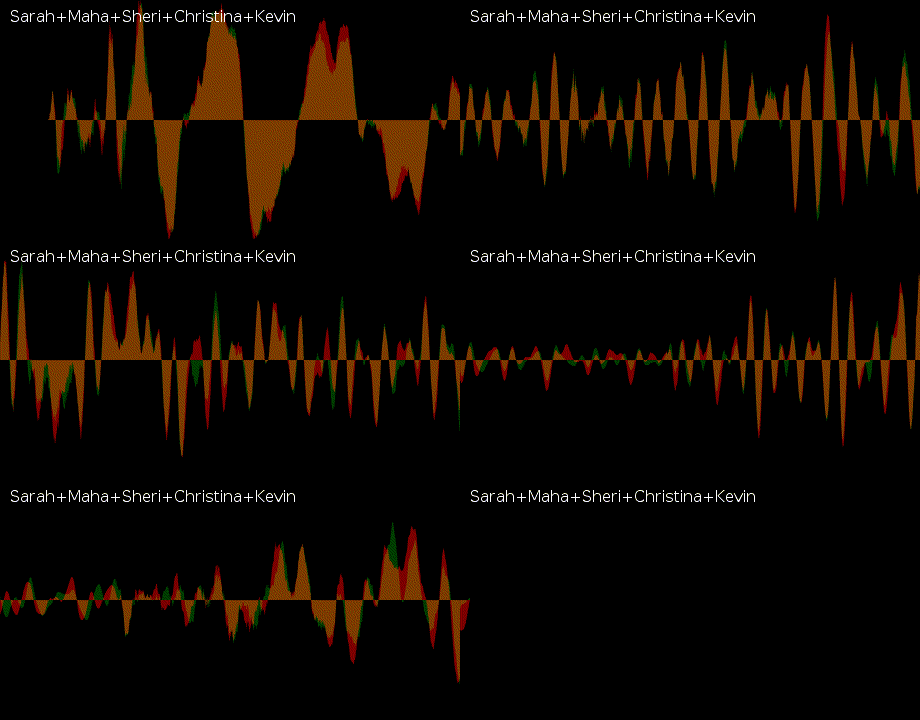
And my curiosity took me a bit further, merging audio with visual. Here is the audio file (or, the first 30 seconds, anyway), remixed as silent waveform:
One final version, using imagery generated from the audio file, and then mixed in iMovie:
CLMOOC friends gathered and created artwork for a collective calendar for the 2022 year. Download it for free, if interested. I composed a short piece of music for each month as my contribution, and I am sharing out each month’s track at the start of each month.
The very first songs I ever wrote and then recorded were done on a little Tascam Four-Track machine that a friend (Murph) borrowed from another friend (Eric), and we set it up in a basement room in my house. We were teenagers. We used a microphone to record some Casio keyboard drums, and layered other sounds, and added vocals (ack), and the magic of the moment when we had a “mix” of that first song was … amazing.
You can even take a listen (because I try to keep everything). The song is called Follow That Dream. It’s hard for me to listen — the lyrics, the voice, the mix … but you can hear some of what we were trying to do with our production as beginners. What you can’t hear is how excited and focused we were, to be recording songs we had written.
In this oversized (and pricey) table book — full of cool photographs of underground and independent musicians across genres and genders — the three men (Tweedy is the son of Jeff Tweedy, of Wilco, but an accomplished drummer and producer in his own right) dig deep into what makes music makers creative, and how a home studio format (either simple or complex) helps these artists to chase their musical threads.
I found every page fascinating, even though I barely know any of the artists in this book. What struck me was the articulation of the creative mind at work, and the desire to make music and follow your paths, for yourself first, and maybe the world, second. These musicians are driven by the need capture the sounds and songs they hear and feel, with little regard for audience (at least, in the making of music part of things).
While some of the discussions went technical (about microphones and set-ups and software), Tweedy always seems to ground the discussion to the creative mind, and to the motivation, and to what it is about recording your ideas on your own that keeps the flame of making songs alive for each of these artists. The first section of the book is mostly photographs, intimate shots of people’s bedroom studio spaces (sometimes, it’s just a bed with a laptop and a guitar), with some enlarged quotes, and the second half is packed with interviews with the people. I enjoyed both parts, and the book itself is a beautiful piece of visual art.
After my friend, Murph, and I recorded those first songs, we were able to “steal time” at night one summer in another friend’s garage where he was slowly setting up recording equipment. We’d tinker in there, and make some tapes, and sit and listen in the car.
Later, I saved up and bought my own Tascam (which, reading here in this book, was a revolutionary product for many musicians, for its affordability and its ability to layer four tracks, or more, if you bounced tracks down) and I spent countless hours in my room, by myself, playing around and experimenting. (Murph, my friend, later went on to build his own recording studio as a business.)
These days, I mostly use an online site to record and layer tracks, although I have an old Tascam in the basement and a cardboard box full of master tapes somewhere (probably gone bad with time).
And I am still mostly writing for an audience of one — myself, and the hope that I will stumble upon something interesting, and follow that path into a song. When it happens, there’s nothing quite like it. That’s what Mirror Sound captures on the page — that sense of wonder and magic of making music.
My friend and collaborator Terry Elliott has been on a “re-wilding” learning adventure, an internal and creative ‘hike’ of art and remix through words and poems and stories and media, and as is his nature, Terry has often invited others along.
I pulled out my keyboard and plugged it in, found an interesting sound, and then with my left hand, I just sort of dropped it on the lower keys. It’s possible my fingers knew how to find a chord on their own (not that I am a keyboardist but I can do some basics) but the dissonance reverberation of where my fingers landed spurred my right hand to find a note, and then another, and soon, I had a melody developing. (Later, I wondered if I had pirated that melody line from somewhere else … it arrived so easily that I figured, maybe it’s not mine.)
I began to shift my left hand, too, moving the pattern of hand-drop around a bit, but intentionally not paying attention to where my fingers were landing. Eyes closed now. My attention was on the sound, and the small gaps where dissonance and tension opened up into something clearer, and my simple melody lines of my right hand continued to dance over the top of those “chords” of my left hand.
This took me all of about ten minutes to complete, with no planning and very little thinking and the record button “on” and, you know, I liked the results very much. I added the music to an image rendition of Terry’s poem. Trailblazing is always worth the time.
I’ve been having some remix fun with an original song that my friend, John, and I wrote and recorded and share out this time of year. The other day, I did a more classical instrumentation remix (see below) and then, I went in another direction entirely for this one (see above). I tried to give it a little more funky beat. (And played around with the image cover).
The first remix:
And the original (recorded in a studio, with video produced by my son):