Book Review: Don’t Call It Art

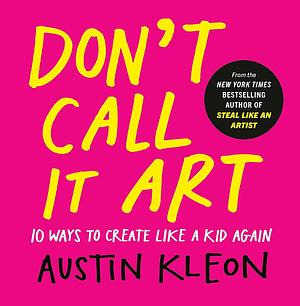
Austin Kleon has long been on my list of folks to follow for advice and inspiration. I, too, am a creative person myself who likes to tinker across mediums (music, writing, art). His new book — Don’t Call It Art — is a collection of ideas of how adults can remember how to play and make art and other things with the energy and imagination of children, who ignore rules when making what they want to make. I loved the collections of blackout poems and artwork in Kleon’s most recent book (his most famous is probably Steal Like An Artist).

The subtitle? 10 Ways To Create Like A Kid Again. Yep. That tracks.

He advises us to ignore rules and instructions, to give ourselves permission to make art that is bad or unrecognizable, to remember that the inputs (reading, museums) are ways to spark more interesting outputs, and that nothing is wasted — even ideas we give up today might spark something tomorrow. And more.

Time to make something …

Peace (on the page),
Kevin

Book Review: Thunder & Lightning (Weather Past, Present, Future)

Thunder & Lightning: Weather Past, Present, Future by Lauren Redniss

I am hard-pressed to describe the experience of reading Lauren Redniss’ Thunder & Lightning (Weather Past, Present, Future). The graphic look at weather and its many different strands of topics is illuminating, immersive, provocative and instructive — in all the good ways imaginable.

With sections centered on topics ranging from Chaos to Wind to Dominion to Forecasting and more, this over-sized illustrated book is a work of art (even the font – named after an Inuktitut word for “falling snow” is magical) that bridges many elements of weather and climate, and human experiences, and braids them together in ways that are unexpected.

It’s clear that Redniss has done her homework here, as her inclusion of so many voices and interviews — set against her powerful artwork and her own observations — provide a deep dive. And it’s all so poetic, too.

It’s a long book — at more than 250 pages — but I found myself so intrigued by it that I finished it within three days. Each sitting left me thinking of something new – about the way fog impacts a sense of being in the world, or how global winds bring sand and dust from Africa to Florida, or how some people make money through weather derivatives, or how an effort to run a hose into the atmosphere to release sulfate dioxide to reduce sun exposure to earth, and much more.

Peace (and wonder),
Kevin

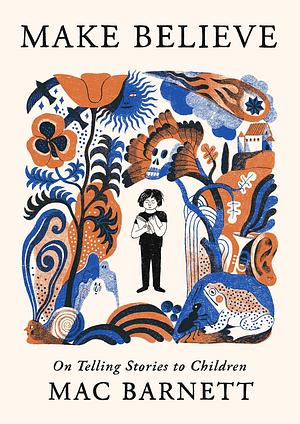
Book Review: Make Believe

This short but jam-packed book by Mac Barnett makes the strong case for children’s books that are filled with imagination rather than life lessons. Barnett, in a very engaging voice, shows how picture books and young adult novels have their own space apart from books for adults, and how we should value what sparks thinking in young people.

He argues against the idea that children’s books should have educational or moral messaging, and instead, he wants weird, strange and intelligent stories that spark thinking in the young readers in unusual ways. He uses Goodnight Moon by Margaret Wise Brown as one example to show how a classic picture book pushes against genre and labels, and breaks a few rules along the way, to spark young reader interest (and it worked, given the book’s classic nature and endurance across generations).

I enjoyed Barnett’s examination of the field of children’s literature in Make Believe, and agree with nearly all of his points.

Peace (and story),
Kevin

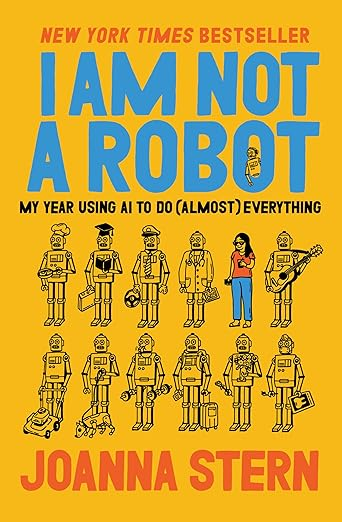
Book Review: I Am Not a Robot: My Year Using AI to Do (Almost) Everything

A.J. Jacobs has carved out an interesting writing career by immersing himself into different scenarios and then writing about it in entertaining and enlightening ways. It’s not a new genre but one I find interesting. Joanna Stern and her new book — I Am Not a Robot: My Year Using AI to Do (Almost) Everything — is in the same vein, and that is not a knock on Stern, a talented technology writer who literally spent the year actively searching out AI to use.

Stern’s approach makes sense in the world we are living in, where AI seems to be everywhere and inevitable. She maps out how she invites AI into her family life — from apps to robots — and casts a critical eye on issues of privacy and transformation of work and play from the infusion of technology. She also writes with humor and compassion, and allows her position as a mother to be forefront in her final analysis of the potential of this technology. She brings robots into her household, uses AI as her therapist and romantic companion (with permission from her husband), and uses the technology to organize her notes and thoughts, allowing it to access her files and record her voice. She goes all out with AI.

And she emerges both impressed and skeptical, and at times, worries. Aren’t we all?

Stern wisely notes that while she, as an adult in these times, has agency to choose whether AI is in her life, her own children and others growing up today might not have those same options. Given the many questions – around privacy, and security, and the unknown — she wonders how young people will navigate the world through inquiry and curiosity, if the answers are just a query away.

Same.

Peace (and wonder),
Kevin

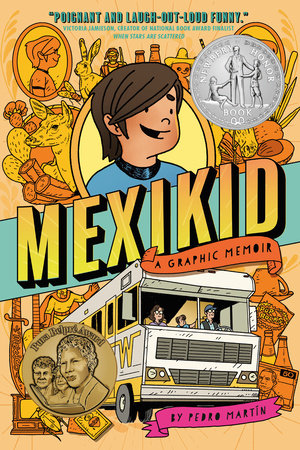
Graphic Novel Review: Mexikid

Mexikid by Pedro Martín

Yeah, there’s a reason Pedro Martin’s Mexikid graphic memoir was on the finalist list for the National Book Award and is on so many Best Books of 2023 lists. It’s fantastic, on so many levels.

Martin weaves a rich story of his family and his own connection to both America and Mexico, as the graphic novel tells the tale of his entire, large family traveling to Mexico in a mobile home and an old truck (there are too many of them to fit in one vehicle) to bring his elderly but still very spry grandfather (Abuelito) to America to live with them. They also need to find a new burial site for the remains of his grandmother, creating a real moment of drama as the family scrambles to remove her bones from a flooding cemetery. (They succeed, but the impact of caring for his Abuelita’s remains is impactful on Martin).

With a deft emotional touch and plenty of humor, Martin’s illustrations and storytelling skills are top notch, and very engaging for the reader. What comes across is the love of family and of the stories of cultural heritage, and how a Mexikid (Martin’s title for someone like him, born in America but with deep roots in Mexico) can thrive by connecting to the stories of elders.

I highly recommend Mexikid for any classroom, but it would have the most impact on middle and high school classrooms, I think.

Peace (and Story),
Kevin

Poem For Raina

Keep Writing, Raina

The prompt at Open Write this morning was to write an elegy for a female author of a banned book or a character in a banned book, and knowing how many of my students read Raina Telgemeir, her book — Drama — came to mind, as I know in some states, it is on the banned list for its depiction of LGBT issues with some secondary characters.

Read more about Drama’s ban.

Peace (and story),
Kevin

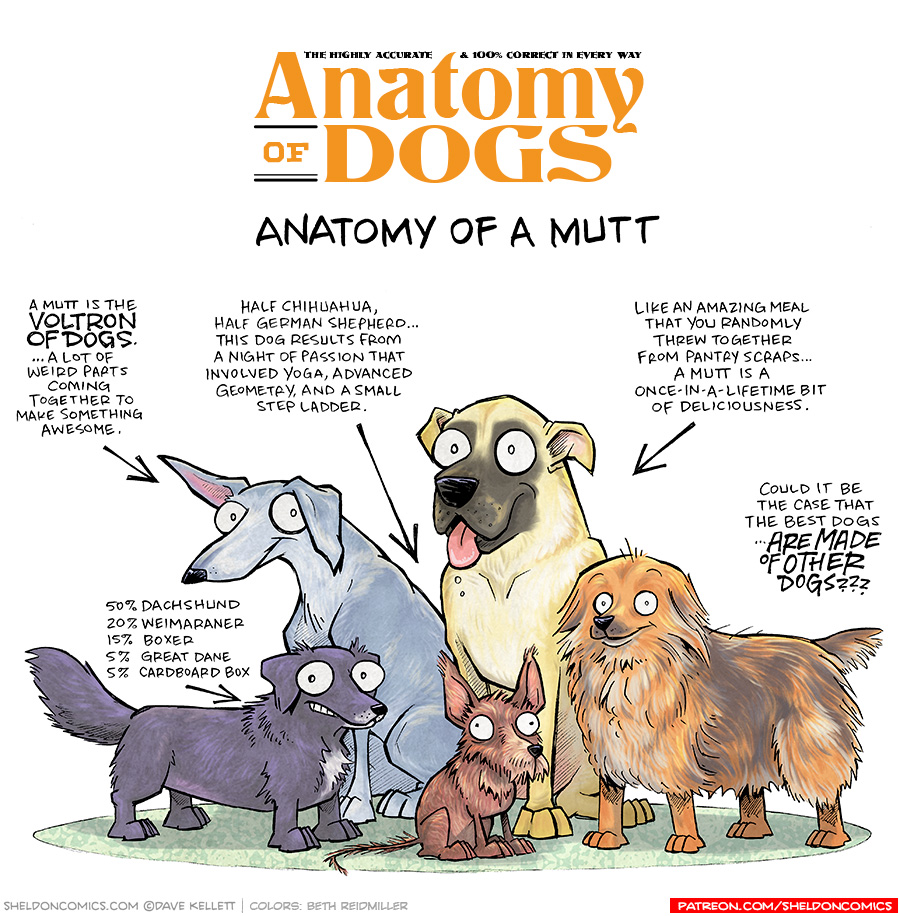
Book Review: Anatomy Of Dogs

Dave Kellett is one of my favorite comic strip artists (see Sheldon) and when he has projects at Kickstarter, I often try to chip in. A recent fundraiser that became a book was Anatomy Of Dogs, a hilarious exploration of breeds of dogs that had me laughing as I read it. He pokes fun, in a fun way, at the attributes of dogs in the form of scientific illustrations. It’s clear that Kellett loves dogs.

Peace (with kibbles),
Kevin

Book Review: The Guerilla Art Guide

I stumbled on this book — Guerilla Art Guide: Everything You Need to Put Your Message Out In The World — in the library by chance and decided, it’s worth a look. Keri Smith lays out a bunch of reasons why taking the art to the streets — in a responsible way — is one way to imagine that the world is really a canvas. The book lays out the philosophical rationale for why a person might want to leave art for the public to stumble upon, and whether political or not, how art might have an influence on the society at large.

There are a bunch of different project ideas — from Wish Trees to the Unexpected Object to Coupon Poster to Postcards — that push back against the idea of corporate advertising in our public worlds. Smith straddles the lines of legality, and urges readers to use material that neither deface any public facades and is kind for the environment.

I liked that the end of the book had a bunch of templates that one could use or remix, for making environmentally-friendly stickers (there is a glue recipe inside the book) and public postcards and more. All in all, Guerilla Art Guide was a quick read but also rather inspirational. I’m now looking at my public places a little differently, noticing the Guerilla art that already exists and thinking of the world as a canvas.

This book had a real CLMOOC feel to it, and I appreciated that.

Peace (it’s there),
Kevin

Book Review: The Lexicon Of Comicana

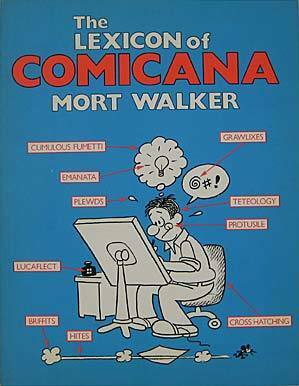
Have you ever wandered into a conversation of people who are in a very specific or specialized field and wondered what language they are speaking? And yet, you are very curious anyway? That was my impression as I read The Lexicon of Comicana by Mort Walker (he, of Beetle Bailey and Hi & Lois comic strip fame).

It was fun to read and to think about the ways in which Walker, and other comic strip makers, have created their own vocabulary for things they do in the world of comic book making. Words like Briffits, and Plewds, and Grawlixes, and Mayhemia all surface, and this book is a light-hearted tome, too, with Walker having fun with the concepts and with us, the reader, as he adds jokes and pratfalls and other visual elements to his explorations of Emanata and beyond.

Famous comic creator Chris Ware offers up the foreword, and talks about how an earlier edition of this book — which is mostly in the form of cartoons and comics, with some adjacent prose — made its rounds through the worlds of cartoonists and graphic novelists in his early, formative years, transforming the way they talked about their art.

This edition that I read is a reprint, and I am happy to have stumbled across it, to know that even academic materials from the world of comics is accessible and fun to read.

Peace (in panels),
Kevin

Daily Create: Haiku To A Book Of Days

SongBook Of Days

I am slow-reading This Year: 365 Songs Annotated (A Book Of Days) by John Darnielle (of Mountain Goats fame) in which he annotates and explains and tells stories of patches of lyrics to songs, one per day of the calendar year (an old format). Today’s DS106 Daily Create prompt asked us to write a haiku for our favorite book. Darnielle’s book is not necessarily my favorite (I am still near the start of the year in his book) but I am enjoying it, as a reader and a songwriter myself.

Peace (day by day by day),
Kevin